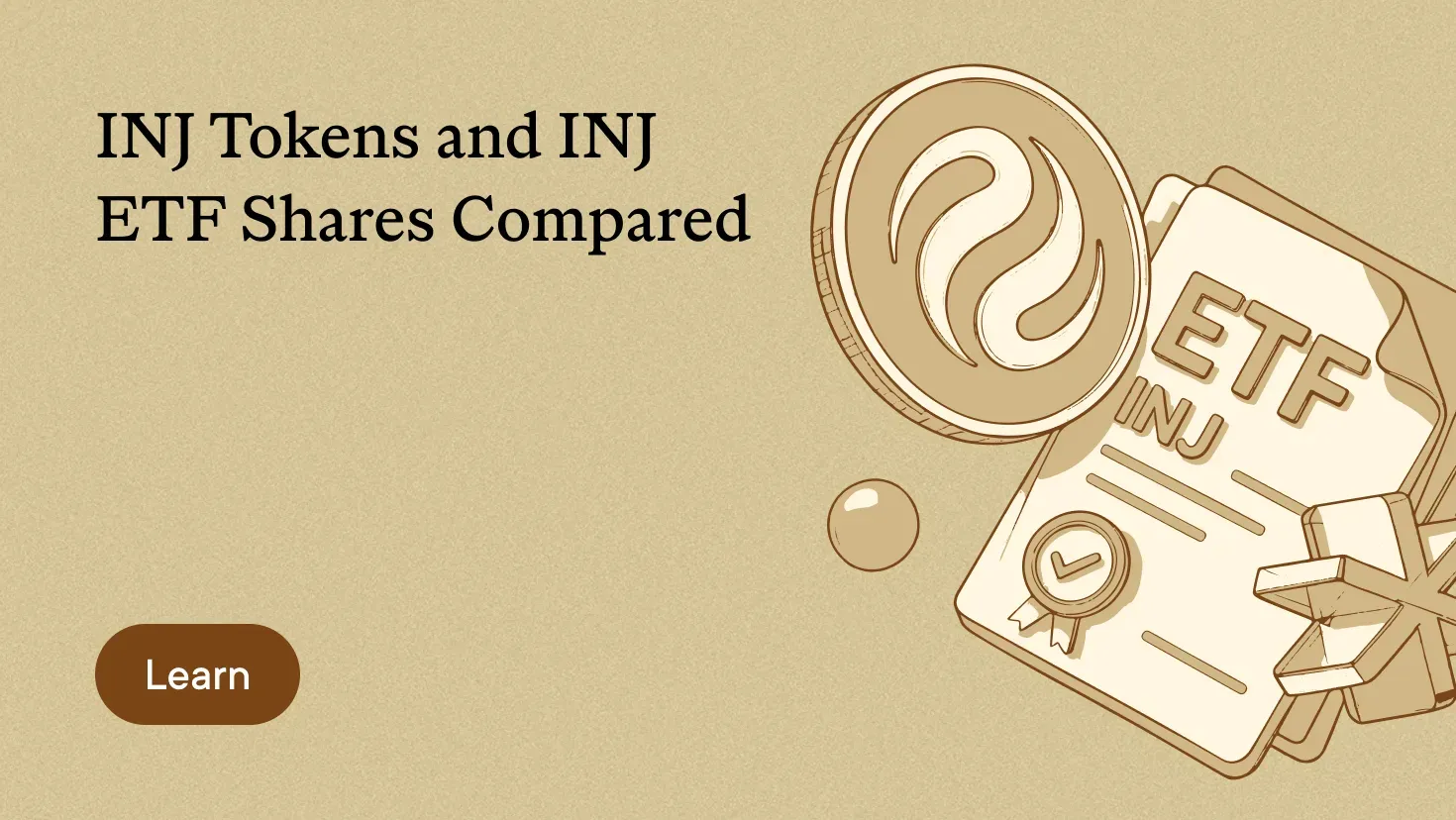
There are two ways to get exposure to the token that powers Injective. You can hold INJ directly, or you can trade shares of INJC through a brokerage account. This guide compares both side by side, covering what you own, who holds the keys, how staking works, what each one costs and the questions new investors ask most.
The Canary Staked INJ ETF brings INJ exposure to the brokerage account. Investors get it with staking built in, through the same account they use for stocks and other ETFs. No wallet to set up and no validator to pick.
If Injective is new to you, here's the quick version. INJ is the native asset of Injective, a Layer 1 blockchain built for finance. People use it to pay network fees, stake to secure the chain and vote on upgrades. Below you’ll find details about the similarities and differences between holding INJ vs. holding INJC.
INJ and INJC Side by Side
| Holding INJ | Holding INJC | |
|---|---|---|
| What you own | INJ tokens | Shares of a fund that holds INJ |
| Where it lives | Your wallet or exchange account | Your brokerage account |
| Who holds the keys | You (or your exchange) | BitGo, the fund's custodian |
| Staking | You choose a validator and stake | The fund stakes part of its INJ and keeps some unstaked to handle redemptions. Net rewards go into NAV. |
| Unstaking | Staked INJ takes 21 days to unbond before you can move or sell it | The fund manages unbonding. You sell shares. |
| Governance | You can vote | You can't vote |
| Use in apps | Yes | No |
| Trading hours | 24/7 on crypto venues | Market hours on Nasdaq |
| Costs | Network fees, exchange fees, validator commission | Sponsor fee, staking fees taken from rewards, brokerage costs |
| Move to a wallet | Yes | No. Shares stay in your brokerage. |
Who Each One is For
Hold INJ directly if you want to stake, vote or use INJ across Injective apps. You manage your own keys, and you can move your INJ onchain whenever you like.
INJC is built for people who want INJ exposure inside the brokerage account they already use, without managing keys or staking themselves. Check availability with your brokerage.
Fees For Each
There are fees associated with each asset. It’s important to understand the differences.
Holding INJ Directly
- Trading fees or spreads when you trade on an exchange
- Withdrawal and network fees when you move INJ, paid in INJ
- Validator commission, a cut of your staking rewards, if you stake
Holding INJC
- A sponsor fee, charged as an annual percentage of the fund's assets and accrued daily
- Staking fees, shared by the sponsor, staking providers and custodian, and taken out of rewards
- Your broker's commission, if it charges one, plus the bid-ask spread on each trade
What INJC's Price Follows
One INJC share isn't one INJ. Shares have their own dollar price, so compare percentage moves, not price tags.
Every trading day, the fund values its INJ using the CoinDesk Injective rate at 4:00 p.m. ET. That sets the NAV, the value behind each share. During market hours, shares trade at whatever buyers and sellers agree on, which can land above NAV (a premium) or below it (a discount).
INJ never stops trading. If it moves on a Saturday, INJC catches up when the market opens Monday.
The amount of INJ behind each share also shifts over time. The fund pays its fees in INJ, which lowers it, and net staking rewards add INJ back. That's why INJC won't match INJ move for move.
A Few Things to Know About INJC
- The fund holds spot INJ. No futures, no leverage.
- You trade shares on the exchange. You can't redeem your shares for INJ.
- Fund holders don't receive airdrops or forked assets.
- Staking rewards vary and aren't guaranteed.
FAQ
Where Can I Trade INJC?
Through a brokerage account, by searching the ticker INJC. Whether you can trade it depends on your broker, your account type and where you live, so check availability with your brokerage.
Can I Hold INJC in an IRA or Other Retirement Account?
That's up to your broker and the type of account. Ask your broker whether INJC is eligible in your specific retirement account before you place an order.
Can I Trade INJC Outside the US?
It depends on your broker and your country. A guide in your language doesn't mean the fund is available where you live.
How Much Do I Need to Start?
The fund doesn't set a minimum. You need enough for one share at its market price, or less if your broker offers fractional shares.
Can I Swap My INJ for INJC Shares?
No. Only large institutions called authorized participants create shares with the fund, in blocks of 10,000. To switch, you'd trade INJ for INJC shares with cash.
What If My INJ is Staked?
Unstake it first. Staked INJ takes 21 days to unbond before you can sell or move it, and it earns no rewards during that window.
Can I Hold Both?
Yes. They live in different accounts and do different jobs. INJ in your wallet can stake, vote and move onchain, while INJC shares sit in your brokerage next to the rest of your investments.
When Can I Trade INJC?
During Nasdaq's trading hours, 9:30 a.m. to 4:00 p.m. ET on weekdays, plus any extended hours your broker supports. INJ trades 24 hours a day, 7 days a week across centralized and decentralized exchanges.
Does INJC Pay Out Staking Rewards?
Not as cash. The fund restakes its net rewards, and they show up in NAV. Rewards vary and aren't guaranteed.