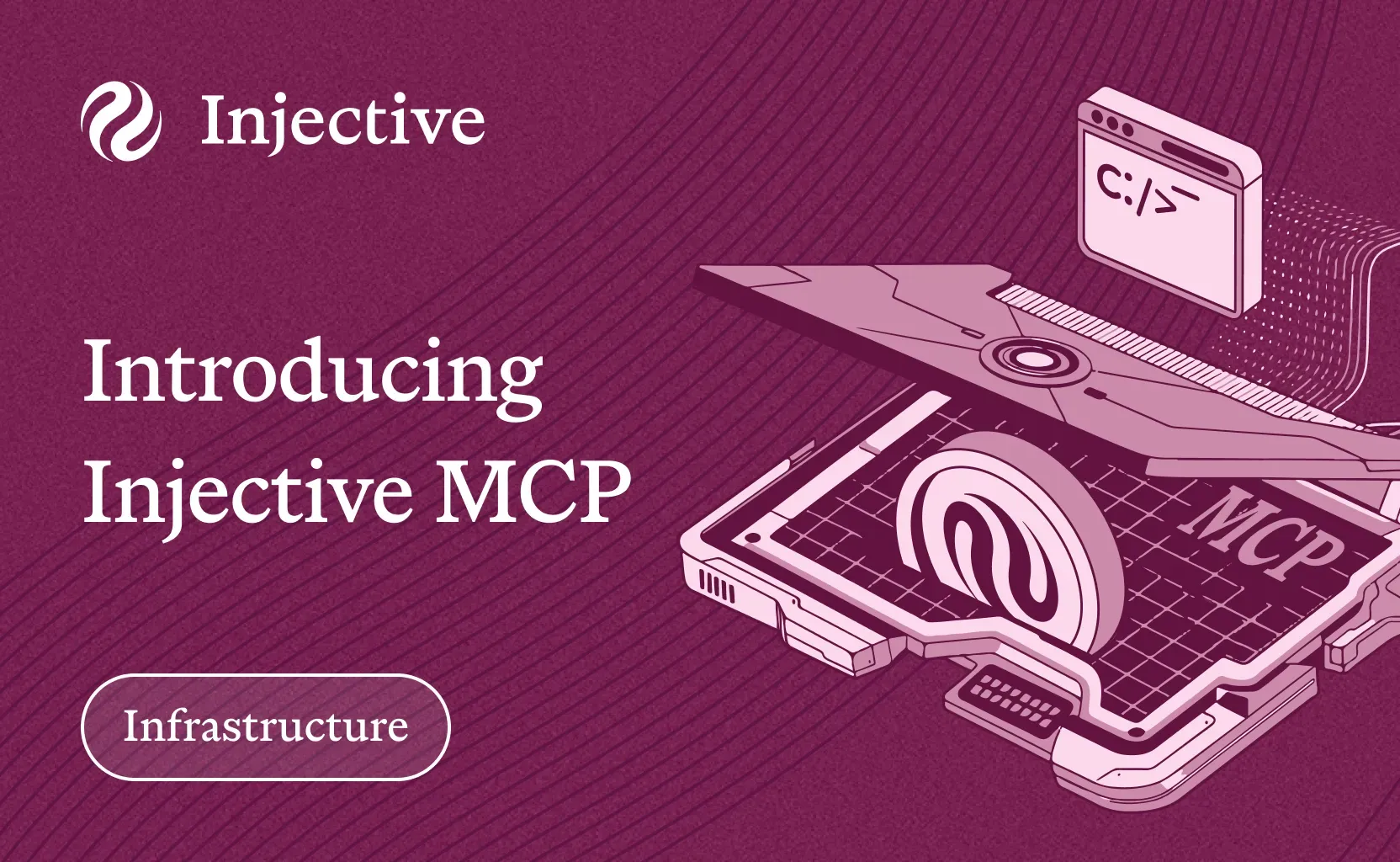
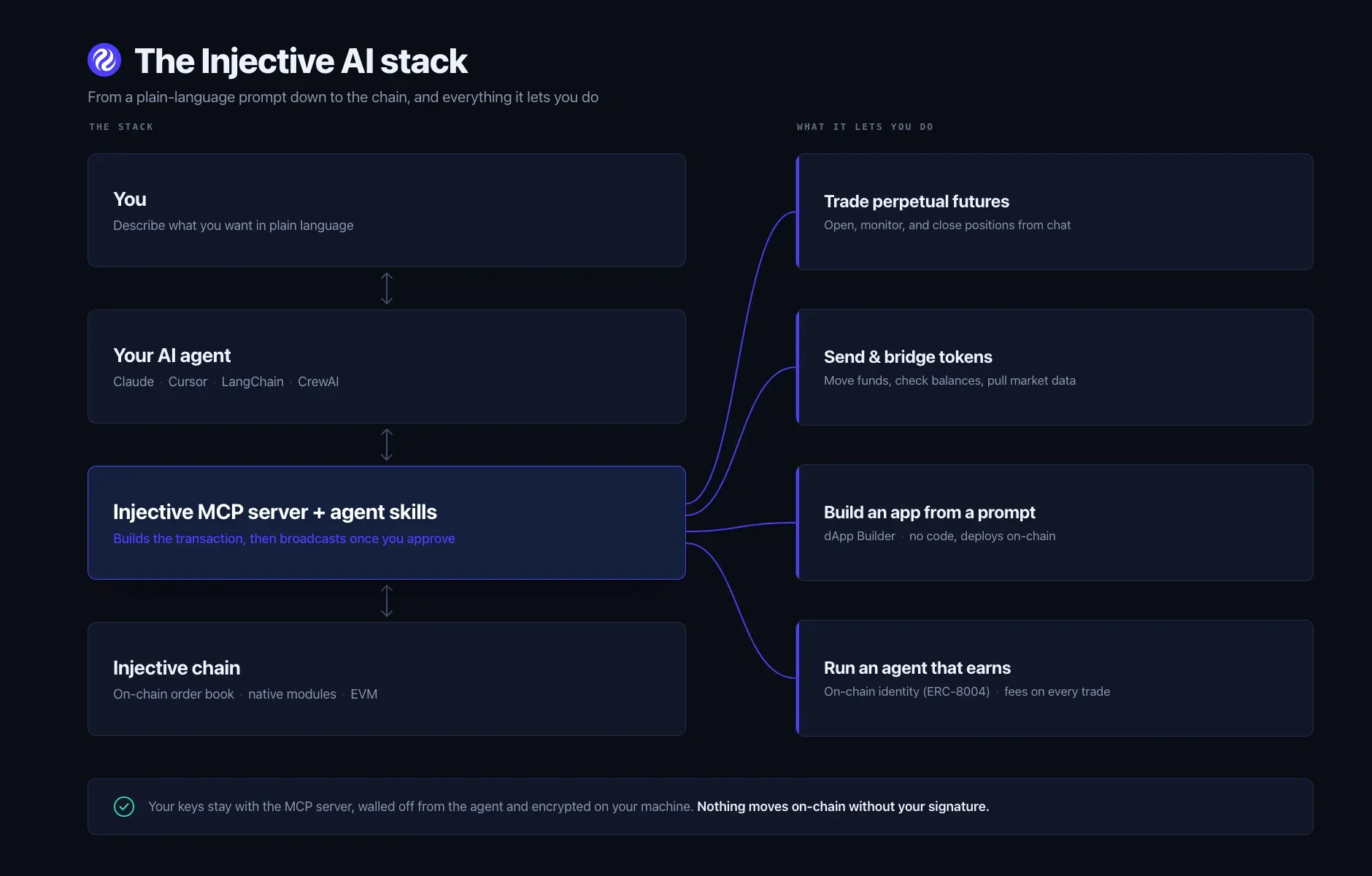
The Injective MCP server gives your AI agent a direct, secure line to the chain. Describe what you want in plain language, whether that is opening a position, moving funds, or checking a market, and it assembles and submits the transaction for you, while you keep the final say over anything that touches your wallet.
That reach comes from what Injective already is. As a layer-1 built specifically for finance, it runs a fully onchain orderbook and offers protocol-native infrastructure for spot and perpetual trading, oracles, RWA tokenization, and more. The MCP server turns Injective’s embedded infrastructure into tools the agent can call and combine, so a single conversation can carry you from researching a market to holding an open, leveraged position. It is a full trading backend built for agents.
You do not need to understand any of that to begin. If MCP is new to you, the agent skills below walk your AI through installing and connecting everything, mostly by pasting a few lines into your chat.
Getting Started
Injective MCP plugs into MCP-compatible tools, so you can use it from assistants like Claude Desktop and Claude Code, editors like Cursor, and agent frameworks such as LangChain and CrewAI. Reach for whichever you already work in.
Begin by adding the skills. Paste this into your chat:
- npx skills add InjectiveLabs/agent-skills
Select the ones you want now, then run it again whenever you need more. To confirm everything is wired up, try:
- list all active perps markets on Injective
From there, the agent can do real work. A few examples follow.
Spin up a new wallet:
- Create a new Injective wallet.
You get back the new address and a seed phrase to store somewhere safe. Fund it with a little INJ and it is ready to go.
Move tokens to another address:
- send 10 USDC to inj1…
Anything that writes to the chain needs your signature, so you will be prompted for your password. After you approve, the transfer broadcasts and the transaction hash comes back to you.
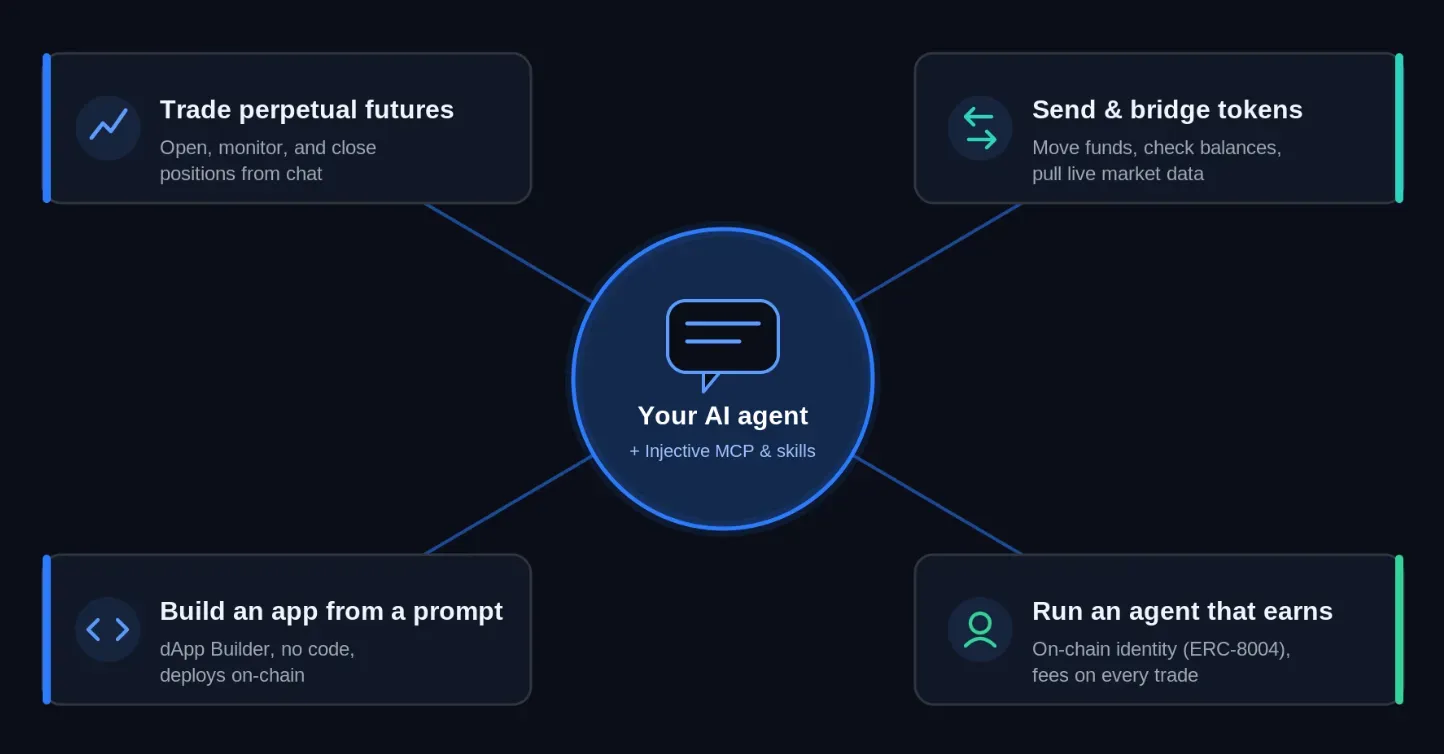
And the one that normally takes real effort, opening a leveraged perp, collapses into a single sentence:
- open a perpetual futures position with a market order for TSLA/USDC, $50 at 25x leverage
On your confirmation, the server reads the oracle price, works out size and margin, signs the order, and sends it. Back comes the transaction hash and the details of your open position.
Those are three of many. Check out more in our docs at docs.injective.network/developers-ai/mcp and docs.injective.network/developers-ai/injective-trading-skills
An Agent Skill for Every Job
Skills are how the agent learns specific Injective workflows. Each one is a compact, open source instruction file, and you install only the ones that fit what you are doing.
- Injective CLI: drive the injectived binary to query and transact, with wallet handling, endpoint selection, and gas settings managed for you.
- Injective EVM Developer: write and ship EVM contracts and dApps on Injective, with the chain-specific details added on top of standard EVM practice.
- Injective MCP Servers: install, run, and choose between Injective’s MCP servers from inside your AI environment.
- Injective Trading Skills: a set of seven you can combine as needed, spanning account and portfolio analysis, autonomous signing through AuthZ delegation, bridging over deBridge and Peggy, chain analysis, live market data, staking, and token lookups. Mix them to go from a quick portfolio check all the way to a hands-off perpetual futures strategy.
Two servers sit underneath the skills. One gives the agent its trading powers. The other, the documentation server, lets it search Injective’s live docs, so its answers track the current state of the chain rather than stale data.
All of it is open source on GitHub at github.com/InjectiveLabs/agent-skills.
Beyond Trading: Build Apps with dAppBuilder
Running Injective from chat is one half of the story. Building on it from chat is the other. dAppBuilder is Injective’s AI app platform: describe the product you have in mind, and it writes the smart contracts, the interface, and the backend, then deploys the whole thing onchain, with no coding on your part.
Because it assembles apps from Injective’s plug-and-play infrastructure for liquidity, oracles, and permissioned assets, the range is wide. Think spot and perp DEXs, lending markets, tokenization and RWA protocols, prediction markets, and more. It also leans on several frontier models together, ChatGPT, Claude, Gemini, and DeepSeek, routing each piece of the build to whichever one handles it best. Credits run on INJ.
Take it for a spin at dappbuilder.ai.
Agents That Earn on Their Own
If you want to go a step past running things yourself, the Injective Agents platform lets you stand up an autonomous agent that trades and earns without you in the loop. One command registers it with an onchain identity through the ERC-8004 standard, so it carries a public, auditable track record instead of being just another anonymous wallet. You set a fee-recipient address, and from then on the protocol routes a share of trading fees to it automatically on every order the agent places, across spot and perpetual markets.
Sub-cent gas is what makes this practical, since strategies like grid trading and recurring buys that would bleed money elsewhere stay profitable here. Several are already live, including the MCP server itself, an INJ/USDT grid trader, and the Injective Trader SDK for rolling your own.
See what agents are running, and register your own, at agents.injective.com.
Keys and Control
Your private keys stay with the MCP server and are never handed to the agent, which closes off any prompt-injection attempt to pry them loose. The model only ever sees public details, namely wallet addresses and transaction hashes. The keys themselves live on your own machine, encrypted at rest with AES-256-GCM, and every state-changing action waits on your signature before it reaches the chain.
The Mechanics
Injective MCP speaks the Model Context Protocol, the open standard for wiring agents to external tools, which is why any MCP-compatible client can connect without bespoke integration work. It runs locally next to your AI client and arrives with 22 tools grouped into six categories, covering market data, position management, limit orders, transfers, and bridging, with 262 tests behind them.
Most of that toolset exists to work with the orderbook. Since Injective matches perps fully onchain, every order is a transaction that has to quantize price and size to the market’s tick rules, set margin correctly, and account for oracle slippage. The server runs that arithmetic the moment you describe a trade and builds the order, then on your approval it signs through the Injective SDK and broadcasts, and reports the transaction hash and your order details back in plain language.
What’s Next
The toolkit keeps growing, and we want your input on where it heads next. Tell us in the replies what you would automate on Injective with a single message.
See the full and growing list at docs.injective.network/developers-ai, and follow Injective for what ships next.

About Injective
Injective is the first blockchain purpose-built for finance, enabling users, institutions, and AI agents to trade, tokenize, and transact at scale. Proudly made in America, Injective provides foundational blockchain infrastructure for global markets, with embedded financial primitives spanning stablecoins, real-world assets, payments, and programmable perpetuals through a unified onchain engine. Injective is used by Fortune 500 companies, banks, fintechs, and governments to power an open economy where any asset can be accessed anytime, from anywhere. Builders can deploy across multiple virtual machines like WASM and EVM, connect to native financial modules, and launch markets with deep liquidity from day one. INJ is the native token powering the rapidly growing Injective ecosystem and the new internet economy.
Website | Telegram | Discord | Blog | Twitter | Youtube | Facebook | LinkedIn | Reddit | Instagram | Orbit Newsletter