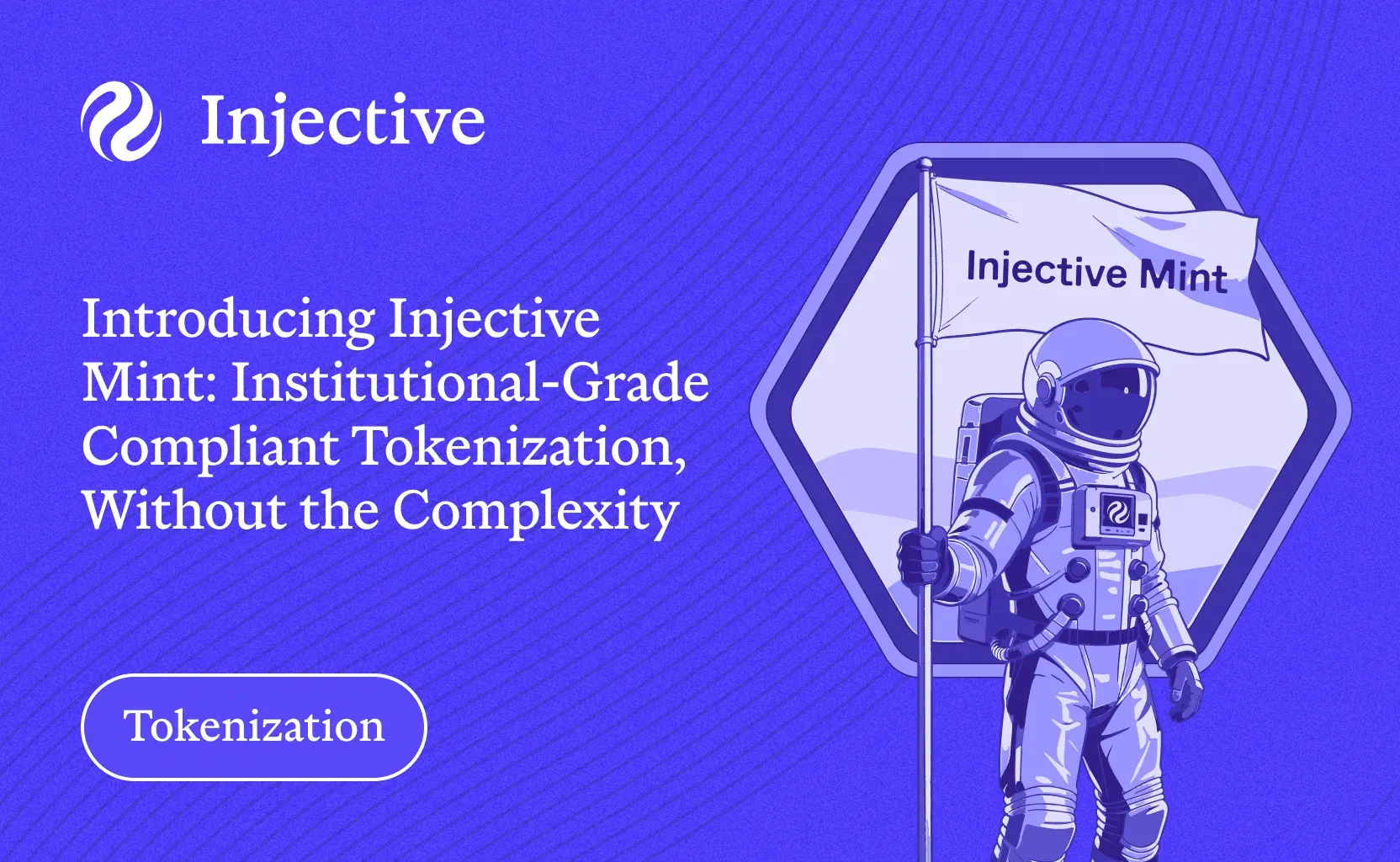
Today, Injective is introducing Injective Mint, a new platform that lets anyone create and manage compliance-ready assets without writing code.
For the first time, the controls required by tokenized treasuries, stablecoins, funds, and other regulated instruments are available through a simple interface. Institutions, users and even AI agents can issue any asset at scale while also customizing every parameter.
Injective Mint is now live in private beta.
Institutional Tokenization, Without the Institutional Overhead
Creating a token takes minutes. Creating one that can operate within the rules of regulated finance has traditionally required custom contracts, manual scripts, and a technical team to maintain them.
That complexity has kept tokenization out of reach for most issuers. Even a basic launch can involve separate systems for issuance, investor permissions, custody, compliance, and ongoing administration. Once the asset is live, changing a role or freezing an address often sends the issuer back to an engineer.
Injective Mint brings those functions into one place.
An issuer can create an asset, configure its permissions, assign administrative roles, and manage it from a single interface. The underlying controls use Injective’s native Tokenfactory and Permissions modules, the same protocol-level infrastructure already designed for institutional assets.
No custom contract is required. No command line is required. The issuer remains in control.
Compliance Is Built Into the Asset
With Injective Mint, an issuer can configure:
- Holder restrictions: Limit who can receive and hold the asset using an approved-address list.
- Approved jurisdictions: Select which regions can access an asset to comply with global legal frameworks.
- Issuance and redemption: Assign minting and burning authority to specific entities while keeping those powers separate from ordinary holders.
- Freeze controls: Stop a compromised or restricted address from transacting.
- Global pauses: Halt all transfers when an operational, compliance, or security event requires immediate action.
- Administrative roles: Give each party only the authority it needs without transferring control of the entire asset.
These are not policies stored in a document or checked after settlement. They are part of the asset itself. If a transfer falls outside the rules, the chain rejects it.
That distinction matters. Regulated assets do not become viable onchain simply because ownership is represented by a token. They become viable when the rules governing ownership and transfer can be applied reliably every time the asset moves.
From Setup to Issuance in One Flow
Mint guides the issuer through the full creation process.
Enter the asset name, ticker, and type. Select the jurisdictions in which it can trade. Set the supply, identify the issuing entity, and add the custodians supporting the asset. Then configure the addresses and roles authorized to hold, transfer, issue, redeem, or administer it.
Once confirmed, Injective writes the asset and its rules to the network in real time. The new asset appears immediately on InjScan, where its onchain activity can be verified.
A process that once required a bespoke technical implementation can now be completed through a repeatable interface.
Issued Into a Live Financial Network
Many tokenization products stop once the asset reaches a wallet. That creates a digital representation, but not a functioning market.
Assets created through Injective Mint enter an ecosystem already built for trading, lending, derivatives, and other financial applications. Subject to the permissions set by the issuer and the integrations available for the asset, an RWA can move into secondary markets, support a lending market, or serve as collateral for new products.
The asset does not need to wait for a separate chain, liquidity layer, or financial stack to be built around it. The infrastructure is already there.
Mint combines simple issuance with enforceable controls and a direct route to onchain utility.
A Platform for Every Issuer
Until now, institutional tokenization has mostly been a custom service for organizations with large budgets and dedicated engineering teams.
Mint makes the same infrastructure accessible to a much broader group. A bank can issue a permissioned deposit token. A fund can tokenize an investment product for approved participants. A fintech can launch a stablecoin with separate issuance, redemption, and compliance roles. An asset manager can bring a new product onchain without building its tokenization stack from scratch.
The institution defines the asset. Injective handles the onchain machinery.
That is how RWAs move beyond isolated pilots. Issuance has to become simple enough to repeat, strict enough for regulated markets, and connected to infrastructure that can make the asset useful after launch.
Creating a Regulated Path for Securities Onchain
Injective has also filed for transfer agent registration with the U.S. Securities and Exchange Commission. If approved, the registration would create a regulated path for Injective to maintain securities ownership records onchain in the United States.
A transfer agent maintains the authoritative record of who owns a security. That record determines who receives distributions, who can vote, and who is entitled to sell or transfer the asset. Today, these records are generally kept offchain and updated across multiple institutions as trades settle.
Moving that function onchain would allow the ownership record to update with settlement, remain open to verification, and operate alongside the asset’s transfer rules.
Mint and the proposed transfer agent capability address two connected parts of the same market. Mint creates the asset and encodes its permissions. The transfer agent would maintain its official ownership record. Both would operate on Injective.
The result would be a more complete foundation for securities issued, administered, and settled onchain.
The RWA Stack Comes Together
Injective Mint adds a new issuance layer to the institutional infrastructure already forming across the network.
Pineapple is bringing mortgage records onchain. INJ has a published MiCA white paper in Europe. Coinbase is supporting the migration to native INJ. The Injective AI Agent SDK lets developers build autonomous agents capable of operating across Injective.
Each development solves a different part of the same problem: how to move real financial activity onchain without giving up the controls, records, liquidity, and infrastructure that markets require.
Mint makes it possible to create those assets at scale.
Live in Private Beta Today
Injective Mint is live in private beta, with support for additional asset types, issuers, and compliance controls planned as the platform expands.
The goal is simple: make institutional-grade tokenization accessible to anyone ready to build the next generation of financial products.
Create the asset. Set the rules. Bring it onchain.
Much more news coming soon.

About Injective
Injective is the first blockchain purpose-built for finance, enabling users, institutions, and AI agents to trade, tokenize, and transact at scale. Proudly made in America, Injective provides foundational blockchain infrastructure for global markets, with embedded financial primitives spanning stablecoins, real-world assets, payments, and programmable perpetuals through a unified onchain engine. Injective is used by Fortune 500 companies, banks, fintechs, and governments to power an open economy where any asset can be accessed anytime, from anywhere. Builders can deploy across multiple virtual machines like WASM and EVM, connect to native financial modules, and launch markets with deep liquidity from day one. INJ is the native token powering the rapidly growing Injective ecosystem and the new internet economy.
Website | Telegram | Discord | Blog | Twitter | Youtube | Facebook | LinkedIn | Reddit | Instagram | Orbit Newsletter