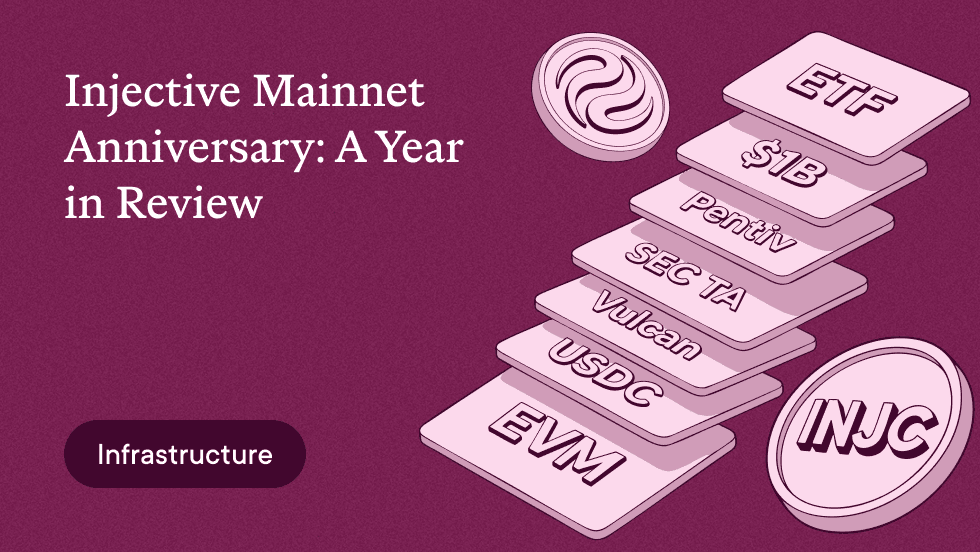
Injective mainnet went live on November 8, 2021. Five years on, it is a blockchain where you can trade crypto, (public & Pre-IPO) stocks, FX and commodities onchain, settle in USDC natively, earn a share of ecosystem revenue through the INJ Community BuyBack and, for the first time, get INJ exposure through a U.S. ETF.
The last twelve months did more to shape Injective than any year before. Native EVM opened the chain to Ethereum developers, more than $12 billion traded on Injective's onchain orderbook, INJ arrived on Robinhood, Coinbase, Revolut and Solana, and companies from a publicly traded mortgage lender to South Korea's largest trading company put real business onchain.
Here are the moments that mattered most, starting with the year at a glance.
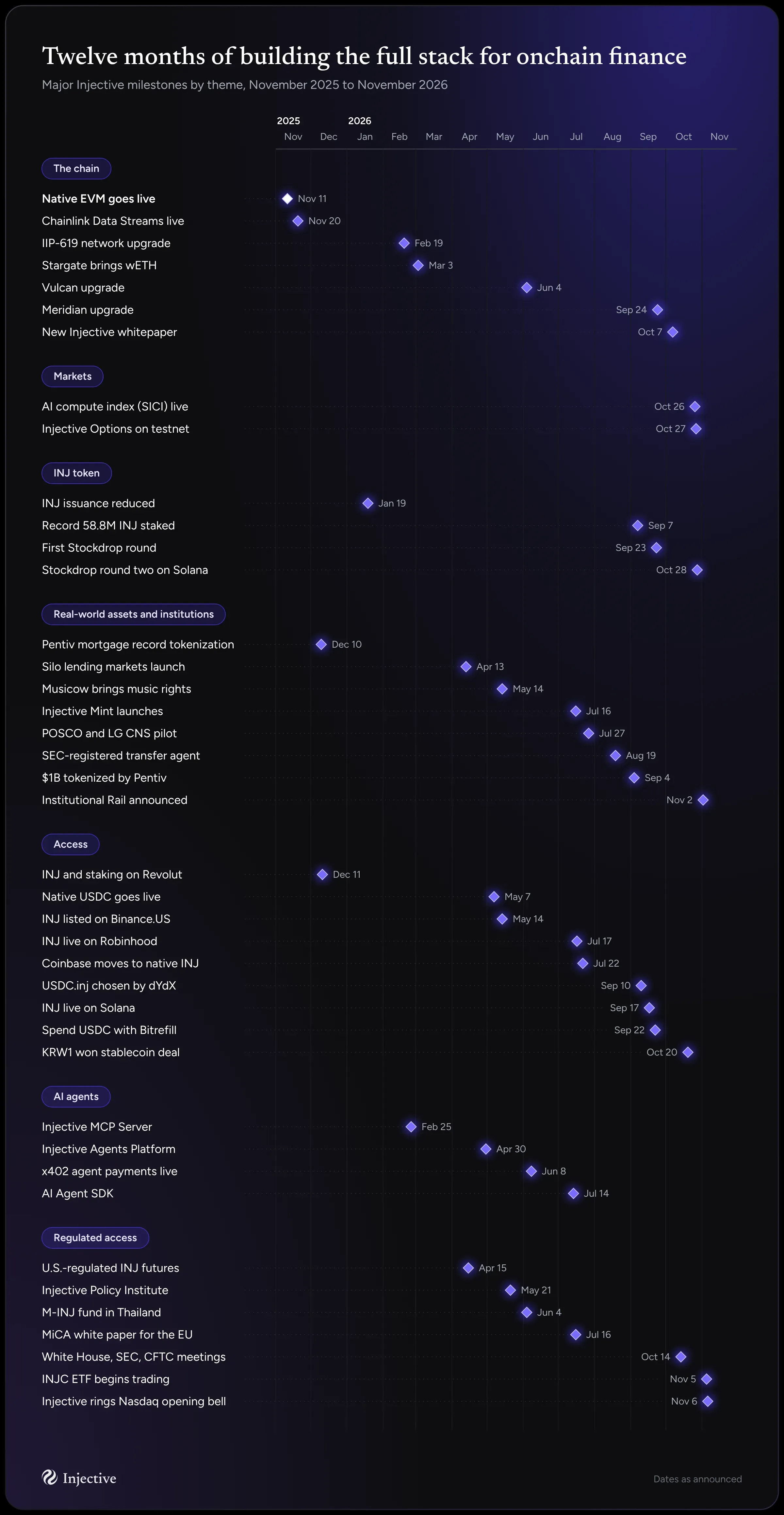
The Chain: One Network for Every App, Asset and Institution
The year, since the previous mainnet anniversary, opened with the biggest upgrade in Injective's history. On November 11, 2025, native EVM went live, so any app written for Ethereum can now run on Injective with the tools its developers already use, such as MetaMask, Hardhat and Foundry. More than 30 apps and infrastructure providers launched on day one.
Injective's EVM shares everything with the rest of the chain. EVM apps tap the same onchain orderbook, the same assets and the same liquidity as every other app on Injective, so a new app has deep markets from its first day. Each token keeps a single balance whether you use it in an EVM app or a WebAssembly (WASM) app, so there is nothing to bridge or wrap, and transactions cost a fraction of a cent. Native EVM brought Injective into the MultiVM future.
Days after native EVM launched, Chainlink Data Streams went live in November 2025, bringing real-time prices for U.S. stocks and ETFs to Injective's onchain markets. Four more network upgrades followed, each approved by INJ stakers through onchain governance. In June, Vulcan rebuilt how Injective handles prices, cutting the cost of oracle updates by 90% and adding Pyth Pro and SEDA feeds for stocks, commodities and other real-world assets. In September, Meridian let companies issue regulated tokens with rules such as who can hold or transfer them built into the token itself, and let EVM apps buy straight from Injective's orderbook in a single transaction.
Then, in October 2026, Injective published Injective: A Finance-Native Layer-1 Blockchain, its first full whitepaper rewrite since 2018. The original described a front-running-resistant exchange protocol on Ethereum. The new paper documents a complete layer-one built for issuing real-world assets and putting them to work across markets, apps and AI agents.
Privacy is next. Banks, lenders and asset managers cannot put client positions or loan details on a public ledger, so Injective is building CypherOS, a native privacy platform for confidential institutional transactions, token issuance and real-world assets. Meridian began testing its first piece, private request-for-quote trading, where a large order can be priced without being broadcast to the whole market.
Each of these changes pushed in the same direction. Native EVM opened the door to developers, Vulcan and Chainlink gave every market faster and more reliable prices, Meridian gave issuers a way to bring regulated assets onchain, and CypherOS will add the confidentiality institutions need. Together they make Injective one network where a trader, an app developer, an asset issuer and a bank all work from the same orderbook, the same assets and the same liquidity, and the new whitepaper is the blueprint for how those pieces fit. That foundation is what made the rest of this year possible, from more than $12 billion in onchain trading to the institutions now building on Injective.
Markets: More than $12 billion traded onchain
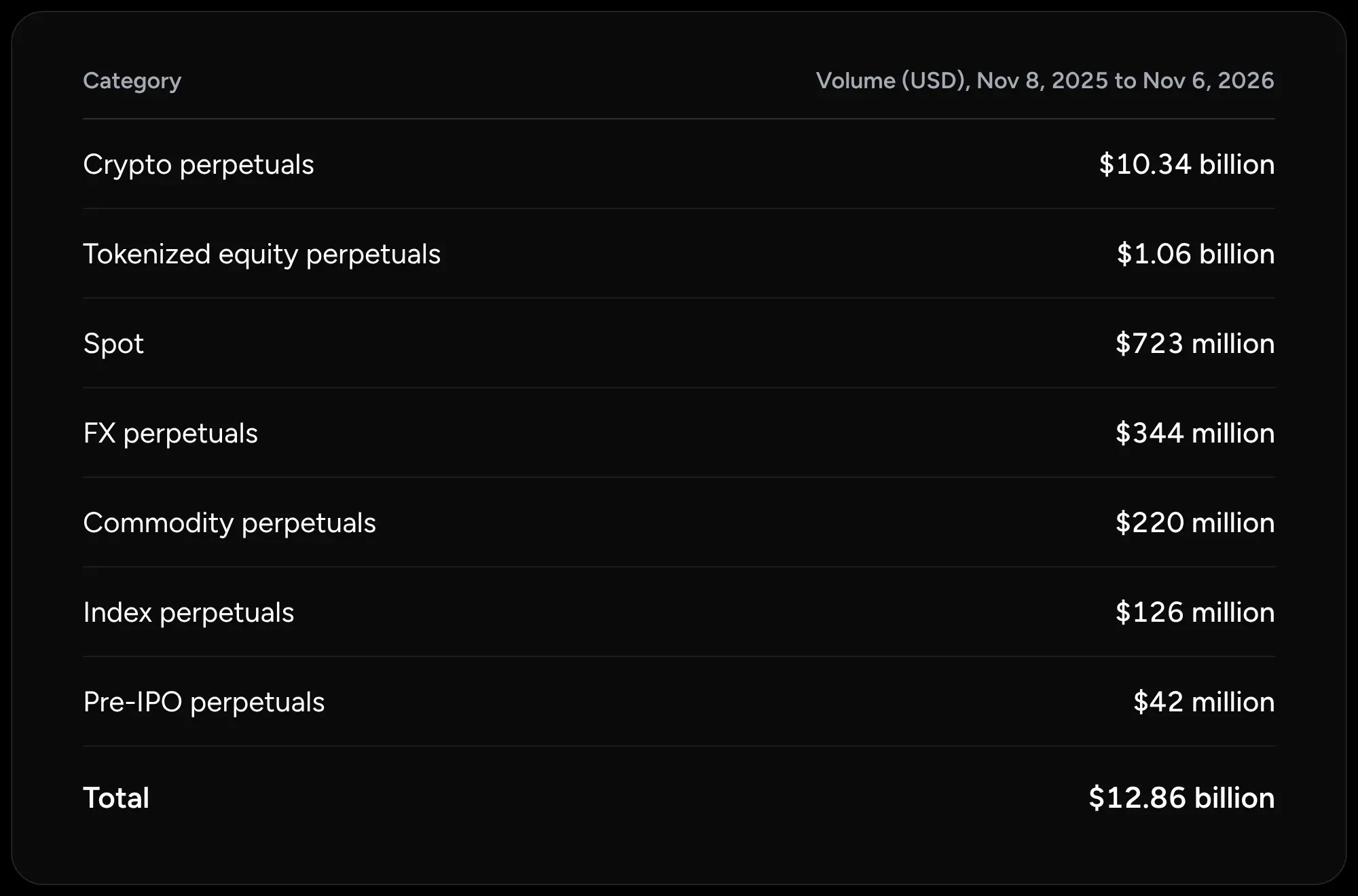
From November 8, 2025 through November 6, 2026, $12.86 billion traded on Injective's onchain orderbook. Every order, match and settlement happens onchain, and every app on Injective can draw from the same shared liquidity. Crypto perpetual futures led the way. Perpetuals on real-world assets, which let traders go long or short on stocks, currencies, gold and oil at any hour, traded nearly $1.8 billion over the year and had their busiest month in October. Tokenized stocks were the standout, setting a new monthly record four months in a row from July through October.
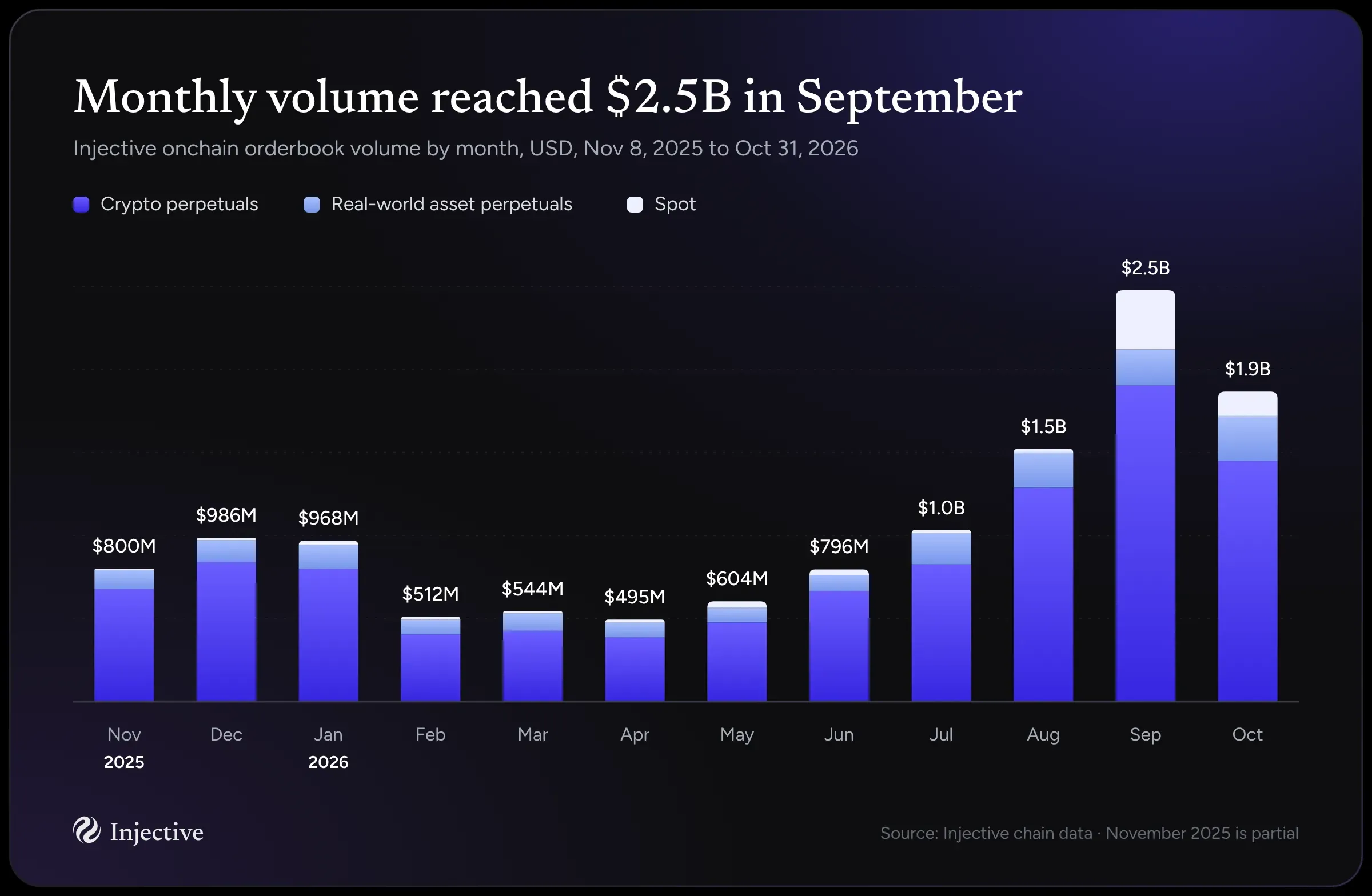
Activity built through the year. Monthly volume roughly doubled between spring and summer and peaked at $2.5 billion in September, the month governance cut spot trading fees on 11 flagship markets by a factor of 500. Spot volume rose about 16x that month.
The year closed with two new kinds of markets. The Super Intelligence Compute Index (SICI) tracks the hourly cost of renting five types of NVIDIA GPUs, from the H100 to the RTX 4090, so traders can take a view on demand for AI computing power. It went live on October 26 as a perpetual with up to 10x leverage.
A day later, Injective introduced Injective Options, a new onchain primitive for European-style calls and puts settled in USDC. Each option has a capped payout that the seller locks up in advance, so buyers know their best and worst case up front and sellers never face margin calls. Builders can launch their own options markets on top of it or white-label options trading in their own apps, and every market built on it can generate revenue for the Injective ecosystem. The first six markets, live on testnet on SICI, the US500 and US Tech 100 indices, gold, silver and oil, are examples of what the primitive can do.
INJ: Burned, Staked and Tokenized Stock Rewards
The INJ Community BuyBack turned one. It replaced Injective's old Burn Auction, where a single winner took the whole pot each week, with a monthly round open to everyday holders. Selected participants commit INJ and receive a proportional share of the revenue generated across the Injective ecosystem, paid in stablecoins and other tokens, and every committed INJ is permanently burned. Demand was immediate: the first round filled in under 24 hours.
Over its first 14 rounds, the BuyBack burned 517,692 INJ. Counting every burn since the first one in 2021, 7,295,039 INJ has now been permanently removed from circulation, with every burn recorded onchain.
In January, Injective voted with roughly 99.9% support to reduce new INJ issuance, lowering the annual range to 2.2% to 4.4% from a planned 4% to 7%. Together with the BuyBack's monthly burns, this ties INJ's supply more closely to activity across the ecosystem.
Holders also staked more INJ than ever, reaching a record 58.8 million in September. Staking secures the network, earns rewards and carries a vote: every staked INJ counts in onchain governance, which approved each upgrade in this recap.
September 2026 brought the launch of the Injective Stockdrop, which adds the chance at a tokenized stock to the BuyBack. Every wallet that commits INJ has a chance to receive one tokenized stock on top of its revenue share, limited to one per wallet each round no matter how much INJ it committed. Round one delivered Stock Tokens on Robinhood Chain, including NVIDIA and AMC, and round two, which went live October 28, delivered tokenized stocks on Solana.
Taken together, this year changed what it means to hold INJ. Holders can stake it to help secure the network and vote on its upgrades, commit it to the BuyBack for a share of the revenue the ecosystem earns, and get a chance at a tokenized stock through Stockdrop along the way.
The design underneath is what makes INJ's tokenomics horizontally scalable. On many blockchains, burns come from transaction fees, so burning more means making the network more expensive to use (congestion-reliant). Injective funds the BuyBack from the revenue apps generate instead, which keeps transaction costs at a fraction of a cent while every new app, market and asset adds to the revenue the community shares in. The other half of the flywheel is supply: reduced issuance works alongside burns that scale with ecosystem revenue. Both are built to keep pace as the ecosystem grows outward, without passing the cost on to users.
Real-World Assets: Real Businesses Onchain
Injective's biggest tokenization story this year is Pentiv, the company formerly known as Pineapple Financial. In December 2025 it began moving its residential mortgage records onto Injective, and by September 2026 more than $1 billion of mortgages were recorded onchain, each record carrying more than 500 data points from the underlying loan. The loans keep their existing legal structure. What changes is the record: one auditable source that lenders, investors and auditors can verify, in place of files scattered across systems. Pentiv's target is its full portfolio of more than 29,000 mortgages, worth over $10 billion.
Large companies are testing similar ideas. In July, POSCO International, South Korea's largest trading company, and LG CNS, LG Group's IT arm, chose Injective for a pilot that tokenizes receivables from POSCO International's real trade flows, with AI agents reviewing the trade documents. Both firms said they picked Injective because compliance controls, such as who can hold or transfer an asset, are built into the protocol itself. Other teams brought novel markets such as music royalties onchain with Musicow.
Injective also built the tools issuers need. Injective Mint, launched at the Injective Summit in July, lets a company create a compliance-ready token without writing code, choosing who can hold it, where it can be sold and who can mint or redeem it. In August, Injective Institutional Services became an SEC-registered transfer agent, the regulated role that keeps the official record of who owns a security. Together they let a company issue a tokenized security on Injective and keep its official ownership record onchain.
On November 2 2026, Injective introduced Institutional Rail, a dedicated connection for banks, trading firms and enterprises. A firm meeting a margin call or a settlement deadline needs to know exactly when its transaction will land. Institutional Rail sends those transactions straight to the validators producing Injective's blocks, includes them on a predictable schedule and confirms receipt before the block is final. Firms keep custody of their own assets, and every order still clears at the same price as everyone else's in the batch, so priority buys timing and never a better price.
Put together, these pieces cover the full life of a real-world asset on one chain. A company can issue a token with its compliance rules built in through Injective Mint, keep the official ownership record onchain through an SEC-registered transfer agent, and settle trades and collateral on a predictable schedule through Institutional Rail, on a network that institutions such as Bitwise, Nansen and Gulf Labs now help secure as validators. Pentiv's mortgage records and POSCO International's trade pilot show real businesses already using that stack, and CypherOS is the next step, adding the confidentiality banks and lenders need before more of their business moves onchain.
Access: Easier to Buy, Hold and Spend
INJ became easier to buy in the apps people already use. Revolut added INJ and INJ staking in December 2025, Binance.US listed INJ in May 2026, and Robinhood followed on July 17, the day after the Injective Summit. Coinbase switched to native INJ in July, and since September Robinhood users can withdraw INJ straight to their own Injective wallet. In both cases INJ now moves directly to the Injective network, with no bridge in between.
Dollars got easier too. In May, native USDC went live on Injective, issued directly by Circle and backed and redeemable like USDC everywhere else. Because it is native, there is no bridged version to trust, and Circle's transfer protocol moves it between Injective, Ethereum, Solana and more than 20 other chains. It replaced bridged stablecoins as the main currency for trading on Injective, and in July Kraken added native USDC deposits and withdrawals.
INJ reached a new community in September. On September 17 it launched as a native token on Solana through Sunrise, with trading on Raydium and Fomo with support on StonkFun for new tokens paired with INJ.
That same month, Injective became the network where USDC is issued for chains connected through IBC, including dYdX, Osmosis and Cosmos Hub, taking over more than $100 million of USDC issuance. dYdX will make this USDC the only collateral accepted for trading on dYdX Chain, so one of crypto's best-known derivatives exchanges, with more than $4 billion in monthly trading volume, will run on dollars issued through Injective. Later that month, Bitrefill began accepting it for gift cards at more than 8,000 merchants, including Amazon and DoorDash.
The Korean won is next. In October, Injective and BDACS agreed to bring KRW1, a stablecoin backed one to one by won deposits at a major Korean bank, onchain for won-denominated settlement of real-world assets. Issuance is pending regulatory approval.
The thread running through all of this is reach. A year ago, many routes onto Injective ran through a bridge. Today someone can buy INJ on Robinhood or Revolut and withdraw it straight to an Injective wallet, bring dollars in from Kraken, Ethereum or Solana as native USDC, and spend them at thousands of merchants. With Injective now issuing USDC for other chains and a won stablecoin on the way, Injective is becoming a starting point for money moving across crypto.
AI Agents: Building the Rails for Agentic Finance
Injective describes itself as the first blockchain purpose-built for finance, where users, institutions and AI agents trade, tokenize and transact at scale. This year the agent side of that idea went from concept to working infrastructure, one layer at a time.
It started with trading. In February, the Injective MCP Server made Injective the first blockchain where AI agents can trade perpetual futures from plain-language instructions. A user can ask an assistant such as Claude to show the BTC market, open a $100 long or check a position's profit, and the agent handles sizing, margin and signing before placing the order onchain. Private keys stay encrypted on the user's own machine, and the AI model only ever sees wallet addresses and transaction results. The server ships with 22 tools covering market data, orders, transfers and cross-chain bridging, and works with Claude, Cursor, LangChain and CrewAI.
In April, the Injective Agents Platform made agents economic actors in their own right. Every registered agent gets an onchain identity through the ERC-8004 standard, which records its type, capabilities and full trading history so anyone can verify its track record. Each agent automatically earns a share of trading fees on every order it places across Injective's spot and perpetual markets, paid straight to its own wallet, and appears in a public registry at agents.injective.com. Registering an agent takes about five minutes and costs less than 0.01 INJ, and open-source starter bots for dollar-cost averaging, grid trading and liquidations give builders a head start.
Payments came next. In June, x402 went live on Injective, letting agents pay for data, APIs and services in USDC in about 600 milliseconds, the time it takes Injective to produce a block, the groundwork for agents buying and selling services from one another. In July, Injective joined the x402 Foundation under the Linux Foundation alongside 40 organizations building the standard, and released the AI Agent SDK, which installs the Injective CLI, both MCP servers and Injective's agent skills into coding assistants such as Claude Code and Codex in one command. With those tools, a developer can describe a smart contract in plain language and have an AI agent write, deploy and verify it on Injective.
Builders noticed. The Injective Nova Program with Microsoft backed AI and Web3 teams with Azure credits and up to $1 million in potential investment, and at AdventureX 2026 in China, where Injective was the exclusive blockchain partner, builders submitted more than 50 projects on Injective, about 30% of the event's total.
Regulated Access: From Futures to an ETF
This was the year INJ entered regulated markets. On April 15, the first U.S.-regulated INJ futures began trading on Bitnomial, a CFTC-regulated exchange, putting INJ in a small group of digital assets with regulated U.S. futures alongside Bitcoin, Ether, Solana and XRP. In May, Injective launched the Injective Policy Institute in Washington to work with lawmakers and regulators on DeFi, onchain derivatives and stablecoins.
Access widened outside the U.S. over the summer. In June, Merkle Capital's M-INJ fund became Asia's first regulated investment fund built entirely around INJ, supervised by Thailand's SEC. In July, Injective published its MiCA white paper and was listed in the EU's MiCA register, opening a regulated path for INJ across the European Union, on the same day it hosted the Injective Summit in Washington, D.C.
The fall brought the U.S. milestones together. On October 14, Injective's leadership met with officials at the White House, the SEC and the CFTC. A day later, INJ reached six months of regulated futures trading, one of the ways an asset can qualify for an ETF under the SEC's generic listing standards.
On November 5, the Canary Staked INJ ETF began trading on Nasdaq under the ticker INJC, the first U.S. ETF for INJ. Investors can now hold INJ in an ordinary brokerage account. The fund holds real INJ with BitGo as custodian, stakes most of it, and adds the staking rewards to the fund's value. ETF applications from 21Shares and REX-Osprey remain under review.
Each step built on the last. Regulated futures opened the path to an ETF, the ETF put INJ in ordinary brokerage accounts, and the MiCA listing and the M-INJ fund extended regulated access to Europe and Asia. Together with an SEC-registered transfer agent and a permanent voice in Washington, that gives everyone from first-time investors to large institutions more regulated ways to reach INJ than at any point in Injective's five years.
Into Year Six
Five years ago, Injective mainnet launched as a home for onchain trading. This year it became something much larger: a single network where people trade, companies issue and record real-world assets, institutions connect directly to block production, and AI agents trade and pay on their own. The numbers bear it out. More than $12 billion traded on Injective's onchain orderbook, the BuyBack burned 517,692 INJ in its first year, more than $1 billion of mortgage records moved onchain, and INJ reached regulated markets in the U.S., Europe and Asia, including its first U.S. ETF.
The common thread is a conviction that has guided Injective from the start: the core machinery of finance belongs in the protocol itself. Orderbooks, issuance controls, ownership records, price feeds and now options are built into the chain, so every app, institution and agent on Injective starts from the same foundation and draws on the same liquidity. Each new market, issuer and builder makes that foundation more useful for everyone else.
Plenty of this year's work is still unfolding. Injective Options is in testing, Institutional Rail is opening to its first institutions, CypherOS will bring privacy to institutional finance, and KRW1 awaits approval. INJ ETF applications from 21Shares and REX-Osprey also remain under review. Each one extends the same stack to more people and more of the financial system.
None of this happens without the people who run Injective: the validators who secure it, the stakers who govern it, the builders who ship on it, and a community that shows up for every day. Thank you for five years of mainnet. Here's to year six.

About Injective
Injective is the first blockchain purpose-built for finance, enabling users, institutions, and AI agents to trade, tokenize, and transact at scale. Proudly made in America, Injective provides foundational blockchain infrastructure for global markets, with embedded financial primitives spanning stablecoins, real-world assets, payments, and programmable perpetuals through a unified onchain engine. Injective is used by Fortune 500 companies, banks, fintechs, and governments to power an open economy where any asset can be accessed anytime, from anywhere. Builders can deploy across multiple virtual machines like WASM and EVM, connect to native financial modules, and launch markets with deep liquidity from day one. INJ is the native token powering the rapidly growing Injective ecosystem and the new internet economy.
Website | Telegram | Discord | Blog | Twitter/X | Youtube | Facebook | LinkedIn | Reddit | Instagram | Orbit Newsletter