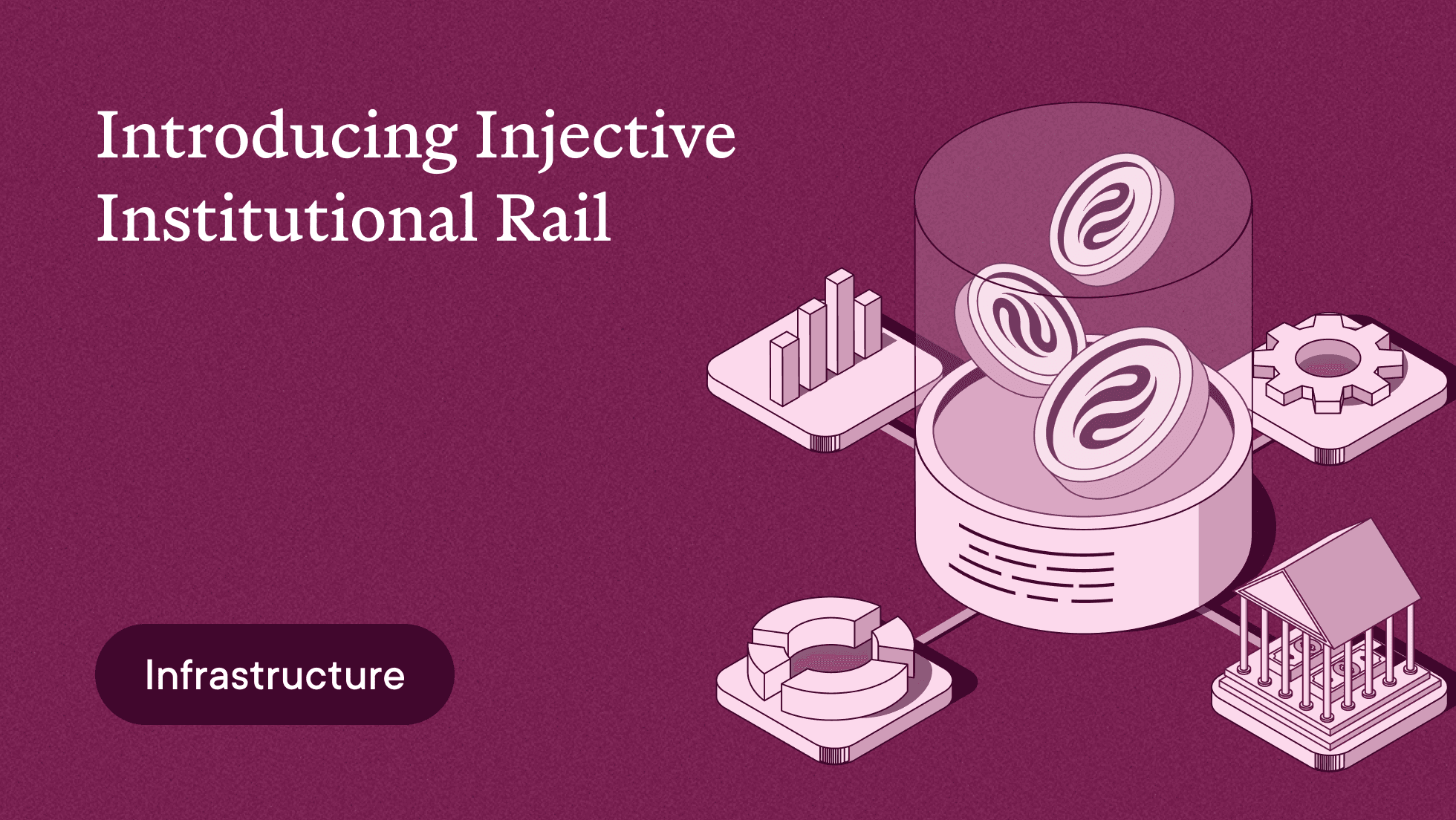
Today we're introducing Injective Institutional Rail, the institutional access layer for onchain finance. Institutional Rail connects financial institutions, professional trading firms and enterprise applications directly to the validators responsible for producing Injective's blocks.
At the core of Institutional Rail is the Enterprise Validator. Institutions submit transactions through a dedicated API rather than public endpoints, which provides two capabilities that shared infrastructure cannot offer. Transactions are included on a predictable schedule, and client systems receive acknowledgement before the block is committed. Settlement remains governed by Injective's validator consensus, firms retain custody of their own keys, and every block is still voted on and finalized by the complete validator set.
Injective’s enterprise validator network brings together some of the most prominent institutions in traditional finance and technology, including Google Cloud, Deutsche Telekom, Kraken, and BitGo. These companies represent just a fraction of the global institutions committing their infrastructure, expertise, and resources to advancing Injective’s financial ecosystem and pushing the boundaries of what is possible with onchain finance. The introduction of the Injective Institutional Rail marks the next major milestone in this evolution, accelerating institutional onboarding, expanding enterprise participation, and unlocking an entirely new scale of institutional activity on Injective.
Built for the Multi-Trillion Dollar Tokenization Market
The world’s largest financial institutions are moving onchain. BlackRock’s BUIDL is the largest tokenized fund in the world, and JPMorgan’s Kinexys network averages more than $5 billion in transactions per day. DTCC set October 2026 for the launch of its Tokenization Service. Citi projects $5.5 trillion in tokenized assets by 2030.
Capital of this magnitude brings institutional operating standards, including firm deadlines, defined risk limits and a complete audit trail. Injective Institutional Rail is designed to meet them.
Why Institutions Need a Dedicated Rail
Institutions evaluate infrastructure on the basis of predictability. A trading firm refreshing quotes must know precisely when its cancellations and replacements will reach the book. An issuer distributing a tokenized fund requires transfers to settle in line with its investor operations schedule. A treasury desk posting collateral ahead of a margin call faces a fixed deadline. When execution timing is uncertain, exposures remain open longer than intended and every downstream process is delayed.
On most public blockchains, institutional order flow is routed through the same endpoints as general network traffic. That architecture serves open access well, but it falls short for firms whose transactions are bound to margin calls, settlement windows and client obligations. Institutional Rail is a culmination of our work with leading institutions to create a new system that meets their true needs moving forward.
The Enterprise Validator Connects Institutions Directly to Block Production
The Enterprise Validator connects to Injective's block production infrastructure through a purpose-built set of APIs. Transactions submitted through the rail go directly into the Enterprise Validator’s mempool for inclusion in the next block, instead of first propagating between validators. This improves execution and further reduces latency onchain.
The model will be familiar to firms that already maintain direct connectivity to exchanges, payment networks and settlement systems. Every application on Injective operates against a single shared state, with native modules for asset issuance, permissions and trading, so one dedicated connection provides access to the entire network. That includes issuing and transferring tokenized assets, settling stablecoin payments, moving collateral and trading on Injective's fully onchain central limit orderbook.
Figure 1 below illustrates transaction flow across Injective, including how transactions reach the Enterprise Validator through the rail and through existing endpoints, with every block still voted on and finalized by the complete Injective validator set.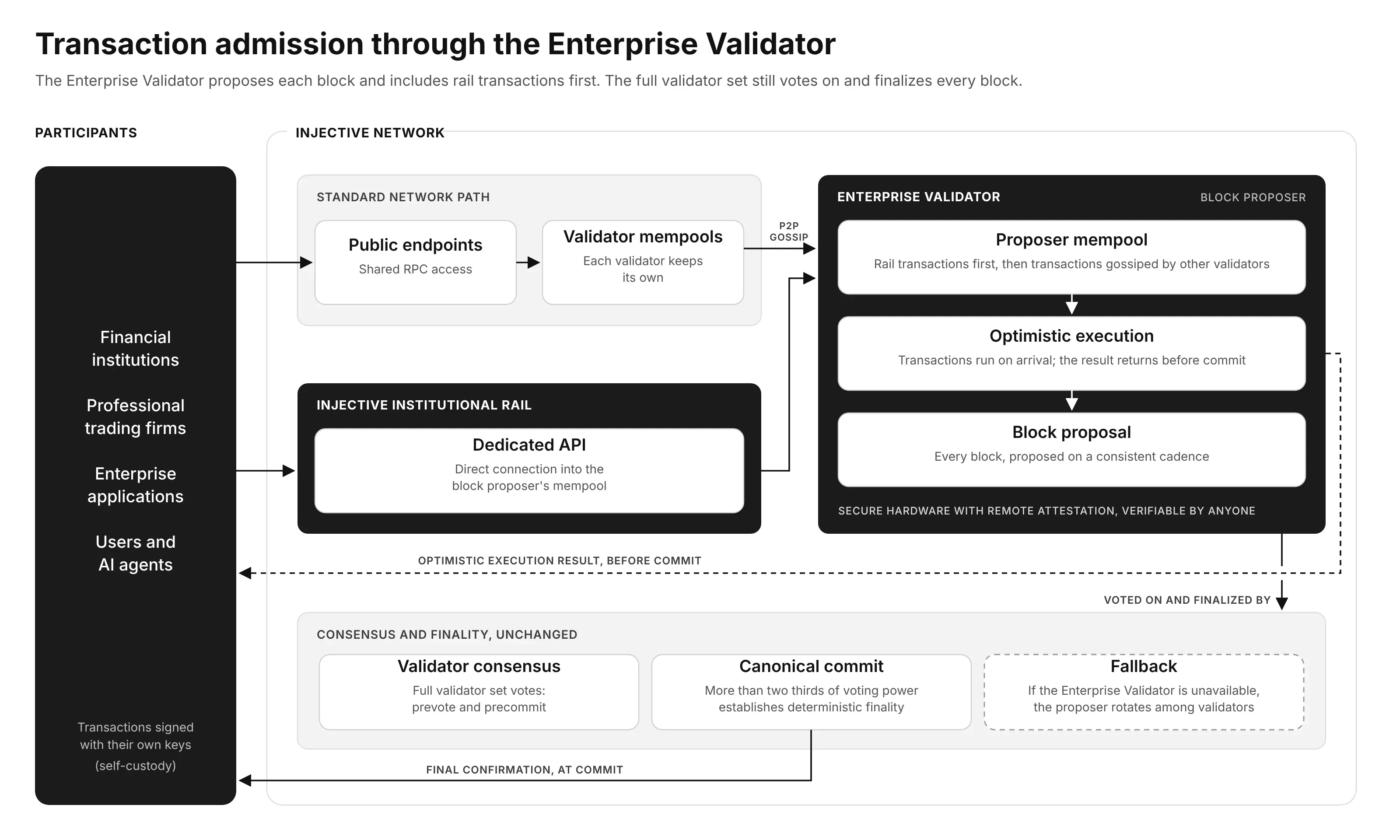
Figure 1: Transaction processing through the Enterprise Validator in the Injective Institutional Rail
Next-Block Inclusion With Fair Execution on Every Transaction
Institutional Rail is designed for consistent block timing and next-block inclusion, allowing firms to plan around when their transactions will be included.
Functional transaction ordering has been integral to Injective's design from the outset. The Injective whitepaper defines four proposal lanes, Oracle, Governance, Exchange and Default, which validators apply when constructing each block. Within the Exchange Lane, priority is determined by fee tier and transaction type. Institutional Rail extends this principle to institutional order flow.
Injective Institutional Rail is built to hold up when it matters most. In volatile markets, when activity spikes and every block counts, transactions sent through the rail keep their place in the next block, and the network keeps producing blocks on a steady cadence.
Next-block inclusion determines when a transaction lands. It confers no pricing advantage. Injective's exchange module clears every block as a frequent batch auction, in which matching orders execute at a uniform clearing price and new orders remain sealed from the resting book until the batch executes; a design that resists front-running and a major class of ordering-based MEV. An order submitted through the rail competes on price with every other order in the batch, precisely as it would without the rail.
A Next-Gen Platform Engineered to Accelerate Trading and Settlement
Once Institutional Rail accepts a transaction for inclusion, it issues an acknowledgement before the containing block is committed. Trading systems can utilize that signal to release subsequent orders. Settlement and treasury systems can update records or flag exceptions well ahead of block confirmation.
The acknowledgement is an operational signal rather than merely acting as a settlement event. Settlement remains the function of Injective's validator consensus. A block is committed once validators representing more than two thirds of voting power reach agreement, at which point the result is final. Injective has no probabilistic confirmation window and no chain reorganizations, and it produces blocks approximately every 600 milliseconds. Institutional Rail shortens the feedback loop without altering Injective’s inherent instant finality capabilities.
Hardware Attestation Built Into Every Connection
The Enterprise Validator operates on secure hardware that supports remote attestation. Before routing any transaction, anyone can request a cryptographic report, signed by the hardware itself, that identifies the exact code executing within the secure environment.
Institutions can therefore rely on verifiable evidence rather than operator assurances. Risk and compliance teams can validate the attestation against the approved software build, retain it as part of onboarding documentation and re-verify it at any time. The same principle governs Injective's markets, where trading rules are enforced as protocol logic executed by every validator.
Enterprise Performance With Full Self-Custody and Deterministic Finality
Institutional Rail introduces an additional pathway into the network while leaving consensus unchanged. That distinction is central to any institutional risk assessment.
Firms retain custody of their own keys and assets, and the service never takes possession of client funds. Validator consensus continues to determine what is committed, so a block produced through the rail carries the same finality as any other Injective block. Should the Enterprise Validator become unavailable, transactions revert to standard network operation for transaction broadcasting and block proposal, preserving continuity of activity.
The design keeps block validation decentralized. The Enterprise Validator runs on a secure trusted execution environment (TEE), and anyone can verify that its code matches the code every other validator runs. Each block it proposes must still be voted on and finalized by the full validator set. If the Enterprise Validator goes offline, block proposal automatically reverts back to active validators and the network keeps producing blocks without interruption.
Purpose-Built for Trading Firms, Issuers, Treasuries and Enterprises
Institutional trading firms gain a predictable cadence for quoting and hedging, with acknowledgements that integrate directly into execution logic. Issuers and tokenization platforms can distribute and transfer assets on timelines aligned with their investor operations. Treasury and collateral desks can meet margin deadlines without prolonging exposure. Enterprise applications receive a dedicated API and an attestation record that compliance teams can review and approve.
The Access Layer for Injective's Regulated Tokenization Stack
The latest Injective whitepaper advances the thesis that the core machinery of a financial system belongs at the protocol layer. Injective is a single chain built for the full lifecycle of tokenized finance, from issuance through settlement. Institutional Rail provides institutions with direct, dependable access to that infrastructure.
Issuance is native to the protocol. Issuers create assets with role-based permissions governing who may mint, send, receive and burn them. The Meridian upgrade in September introduced regulated token implementations on Injective EVM, enabling issuers to embed compliance and transfer requirements directly within tokenized products. Injective Institutional Services is registered with the U.S. Securities and Exchange Commission as a transfer agent, providing a regulated framework for the official ownership records underlying onchain securities.
Institutional adoption is already underway. Pentiv is migrating residential mortgage records onto Injective. POSCO International, South Korea's largest trading company, and LG CNS selected Injective for a live pilot that issues, transfers, administers and settles trade receivables generated by international commerce. Laser Digital's Laser Carry Fund, BlackRock money market products and the Hamilton Lane SCOPE Senior Credit Fund launched on Injective with secondary trading, collateralized lending and portfolio margining.
Native Privacy Is the Next Institutional Upgrade
Predictable access addresses one institutional requirement. Confidentiality addresses another. Lenders, asset managers and banks frequently cannot disclose client positions or loan-level data on a publicly readable ledger. Injective is building native privacy into the protocol layer itself with the upcoming launch of CypherOS, a proprietary platform that aims to focus on bringing confidential institutional transactions, token issuance and RWAs. That work began with the Meridian upgrade, which initiated testing of private request-for-quote flows in controlled environments ahead of a broader privacy suite planned for a subsequent upgrade.
Injective Institutional Rail Brings the Full Financial Lifecycle Onchain
BlackRock, JPMorgan, DTCC and Citi are each building for tokenized markets. The institutions driving this next phase require two properties that have historically been in tension. They seek the openness and shared liquidity that define onchain markets, alongside the operational certainty of the venues they already rely on. Injective Institutional Rail delivers that certainty without compromising openness.
Through Injective Institutional Rail, a firm gains direct access to block production, next-block inclusion, acknowledgement ahead of block commitment and verifiable assurance of the software it routes through. Custody remains with the firm, and finality remains with validator consensus. Together with native issuance, an SEC-registered transfer agent, a fully onchain orderbook and privacy in active development, Injective Institutional Rail enables institutions to issue assets, trade, manage collateral and settle positions on Injective within a single integrated environment rather than across fragmented systems.
Request Early Access to Institutional Rail
Institutional Rail is already in production across a select group of financial institutions, professional trading firms and enterprise teams. Further rollout will be determined on a case-by-case basis. To request early access, contact us directly at institutions@injectivelabs.or

About Injective
Injective is the first blockchain purpose-built for finance, enabling users, institutions, and AI agents to trade, tokenize, and transact at scale. Proudly made in America, Injective provides foundational blockchain infrastructure for global markets, with embedded financial primitives spanning stablecoins, real-world assets, payments, and programmable perpetuals through a unified onchain engine. Injective is used by Fortune 500 companies, banks, fintechs, and governments to power an open economy where any asset can be accessed anytime, from anywhere. Builders can deploy across multiple virtual machines like WASM and EVM, connect to native financial modules, and launch markets with deep liquidity from day one. INJ is the native token powering the rapidly growing Injective ecosystem and the new internet economy.
Website | Telegram | Discord | Blog | Twitter | Youtube | Facebook | LinkedIn | Reddit | Instagram | Orbit Newsletter