Every year, trillions of dollars move through global trade, yet much of the financial infrastructure supporting those transactions remains fundamentally unchanged. Every shipment creates invoices, payment obligations, and receivables that flow across banks, corporate treasuries, counterparties, and subsidiaries, with each institution maintaining its own records before capital can finally settle. While institutional tokenization has accelerated across securities, funds, and treasury assets, the financial infrastructure underpinning global trade has remained largely untouched.
That changes today with Injective.
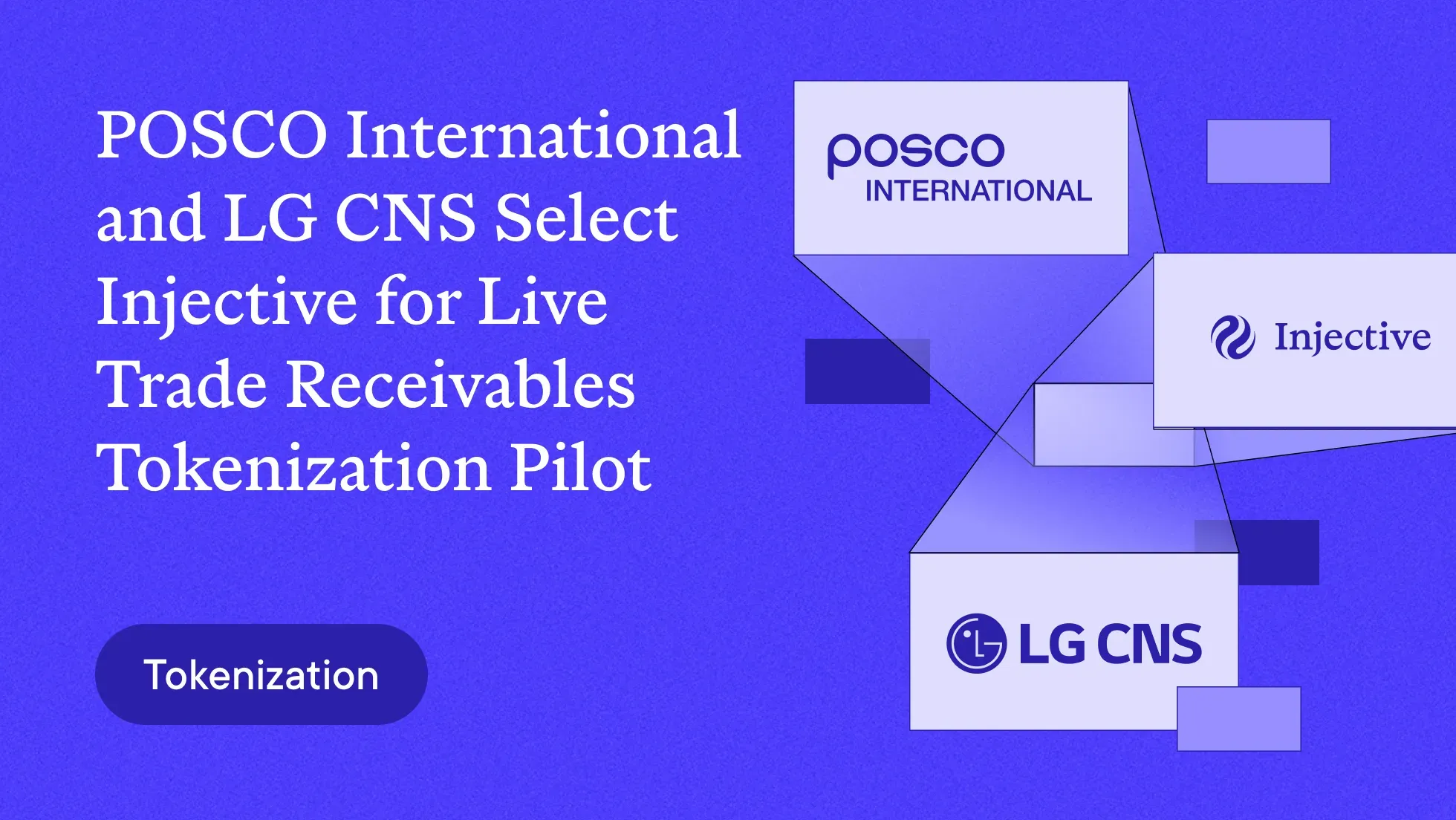
For the first time, POSCO International, South Korea's largest trading company, and LG CNS, the technology arm of LG Group, are bringing live trade receivables generated through international commerce onto blockchain infrastructure purpose-built for finance. The two companies have selected Injective as the network powering a proof of concept that will issue, transfer, administer, and settle accounts receivable originating from POSCO International's existing trade flows between its overseas subsidiaries and counterparties.
Unlike many enterprise blockchain pilots built around synthetic assets or controlled demonstrations, this initiative is rooted in real commercial activity. The receivables being tokenized represent actual payment obligations generated through international trade, providing one of the clearest demonstrations yet of how blockchain infrastructure can modernize operational assets that sit at the heart of the global economy.
The initiative combines blockchain infrastructure, cloud computing, and agentic AI into a unified trade finance workflow. A shared ledger provides participating entities with a synchronized view of every transaction. Trade receivables are issued as permissioned real-world assets on Injective with compliance controls embedded into the asset itself, while AI agents automate the review of Letters of Credit and supporting trade documentation before transactions move through settlement.
The significance extends beyond a single pilot. Trade receivables represent one of the largest categories of real-world assets in global finance, yet they continue to move through fragmented systems designed decades ago. Bringing them onchain requires more than tokenization alone. It requires infrastructure capable of supporting compliance, governance, settlement, and operational controls at institutional scale. For that infrastructure, POSCO International and LG CNS selected Injective.
Modernizing the Infrastructure Behind Global Trade
Trade finance has historically depended on disconnected systems. A single transaction may be recorded independently by the seller, buyer, bank, logistics provider, insurer, and multiple corporate subsidiaries. Each participant maintains its own version of the same commercial event, forcing operational teams to spend time validating documents and reconciling records before settlement can occur.
The result is an infrastructure where working capital remains locked between shipment and payment despite every participant ultimately referring to the same underlying transaction.
The pilot replaces those disconnected records with a shared financial object. Instead of existing as multiple independent entries across different organizations, each receivable is represented as a permissioned digital asset on Injective. Ownership, transfer history, settlement status, and administrative controls remain synchronized across authorized participants, allowing every party to reference the same asset throughout its lifecycle.
Compliance remains embedded alongside the asset itself. Rather than applying operational rules after a transfer occurs, ownership permissions, jurisdictional restrictions, approved-holder requirements, issuance and redemption authority, administrative roles, and transfer controls can all be configured directly into the receivable. As the asset moves between approved participants, the rules governing it move as well.
"This PoC is significant in that it validated the applicability of AI and blockchain technology based on real trade data and processes," said Lee Gye-in, President and CEO of POSCO International. "We plan to finalize a pilot operation framework in the second half of this year, centered on areas where operational efficiency gains were confirmed, and will apply them to actual business operations in a phased manner."
Alongside the tokenization layer, POSCO International and LG CNS are evaluating how agentic AI can improve one of trade finance's most manual workflows. AI agents review Letters of Credit and supporting documentation to identify inconsistencies before they delay settlement. A missing clause or documentation error can prevent payment despite goods already being delivered. Automating these reviews allows organizations to reduce repetitive manual work while improving consistency across international operations.
Why LG CNS Selected Injective
LG CNS is one of Asia's most experienced enterprise technology companies. As the technology arm of LG Group, it has spent years building infrastructure across cloud computing, artificial intelligence, enterprise software, financial systems, and blockchain.
Its blockchain experience extends well beyond traditional Web3 applications. LG CNS developed the Monachain enterprise blockchain platform, deployed digital-currency infrastructure for more than 220 local governments throughout South Korea, participated in the Bank of Korea's central bank digital currency pilot, and built security token infrastructure supporting institutions including KOSCOM and Mirae Asset Securities. Earlier this year, the company also entered into a strategic partnership with Palantir to accelerate enterprise AI adoption across LG Group.
For tokenizing live trade receivables, LG CNS selected Injective.
The decision reflects an important distinction between general-purpose blockchain infrastructure and infrastructure designed specifically for financial markets.
Issuing a token is only one component of institutional tokenization. Financial assets also carry operational requirements governing who may own them, where they may be transferred, who controls issuance and redemption, what jurisdictions they may circulate within, and how they can be administered throughout their lifecycle. Those requirements cannot depend entirely on external applications layered above the blockchain.
Injective was designed to embed these financial primitives directly into the protocol.
Its native Permissions framework allows issuers to configure approved-holder requirements, transfer restrictions, jurisdictional controls, role-based administration, asset freezes, pauses, and separate issuance and redemption authorities at the protocol level. These capabilities are exposed through Injective Mint, Injective's recently introduced institutional issuance platform, enabling organizations to create compliance-ready real-world assets through a unified interface rather than assembling custom smart contracts and administrative infrastructure for every deployment.
For enterprises bringing regulated financial assets onchain, that architecture fundamentally changes the operating model. Compliance becomes part of the asset itself rather than an external process that must be recreated every time ownership changes.
Combined with Injective's sub-second block production, instant finality, and purpose-built financial infrastructure, the result is a blockchain capable of supporting operational assets representing real commercial value rather than simply issuing digital representations of them.
Building the Foundation for Regulated Onchain Finance
The POSCO International and LG CNS pilot represents another step in a broader institutional strategy unfolding across the Injective ecosystem.
In the United States, Injective recently filed its registration with the U.S. Securities and Exchange Commission to become a transfer agent. Transfer agents play a foundational role within capital markets by maintaining authoritative ownership records, processing transfers, supporting new issuances, administering corporate actions, and ensuring the integrity of securities ownership. Injective's filing represents an important step toward bringing those core market functions onchain, allowing ownership records and settlement infrastructure to operate together on the same network rather than across disconnected systems.
Across Europe, the Injective Foundation recently published the MiCA white paper for INJ, completing the notification process under the European Union's Markets in Crypto-Assets framework. The white paper has been included within ESMA's Interim MiCA Register, establishing a standardized disclosure framework supporting potential admission to trading across the European Union and European Economic Area while expanding regulated pathways for institutions building on Injective.
At the protocol layer, Injective Mint extends the network's institutional infrastructure by providing a unified platform for issuing real-world assets with embedded compliance controls. Instead of separately developing permissions, administrative tooling, transfer restrictions, custody integrations, and governance systems, institutions can configure these capabilities through a single issuance workflow built directly on Injective's native financial modules.
Viewed together, these initiatives are not independent announcements. They represent different layers of the same institutional architecture. Regulatory infrastructure. Compliant asset issuance. Enterprise deployments. Each reinforces the next, creating an integrated foundation for bringing regulated financial assets onchain across major global jurisdictions.
The POSCO International and LG CNS pilot demonstrates how that infrastructure extends beyond tokenized securities and investment products into one of the largest operational asset classes supporting international commerce.
Enterprise Tokenization Is Entering Its Next Phase
Much of the industry's attention has focused on bringing capital markets onchain. Treasury assets, money market funds, and tokenized securities have demonstrated that regulated financial products can operate on blockchain infrastructure.
Trade finance represents the next frontier.
Every international shipment generates invoices, payment obligations, and receivables that continue to move through fragmented systems despite advances elsewhere in financial markets. Modernizing those operational assets has the potential to improve how working capital moves throughout the global economy while reducing reconciliation, accelerating settlement, and increasing transparency across multinational organizations.
POSCO International and LG CNS ultimately describe the objective as creating a standardized digital operating framework that scales across subsidiaries, counterparties, and jurisdictions while allowing compliance to remain attached to each asset throughout its lifecycle.
"Injective was built for regulated finance to run onchain, and a pilot of this scale is exactly what it was designed to carry," said Injective co-founder Eric Chen. "When South Korea's largest trading company and LG CNS choose Injective for live trade receivables, it demonstrates Injective's ability to move real capital markets onchain."
The first generation of institutional blockchain adoption focused on proving that traditional financial assets could exist onchain. The next generation will focus on whether the infrastructure underpinning global commerce itself can become programmable.
The work now underway between POSCO International, LG CNS, and Injective represents an important step toward that future.

About Injective
Injective is the first blockchain purpose-built for finance, enabling users, institutions, and AI agents to trade, tokenize, and transact at scale. Proudly made in America, Injective provides foundational blockchain infrastructure for global markets, with embedded financial primitives spanning stablecoins, real-world assets, payments, and programmable perpetuals through a unified onchain engine. Injective is used by Fortune 500 companies, banks, fintechs, and governments to power an open economy where any asset can be accessed anytime, from anywhere. Builders can deploy across multiple virtual machines like WASM and EVM, connect to native financial modules, and launch markets with deep liquidity from day one. INJ is the native token powering the rapidly growing Injective ecosystem and the new internet economy.
Website | Telegram | Discord | Blog | Twitter | Youtube | Facebook | LinkedIn | Reddit | Instagram | Orbit Newsletter
About LG CNS
LG CNS is a digital transformation company and a member of LG Group, founded in 1987 and listed on the Korea Exchange. It builds AI, cloud, data, and blockchain systems for enterprises and the public sector, including the Bank of Korea CBDC pilot and security token platforms for Korea's financial institutions.
About POSCO International
POSCO International is South Korea's largest trading company and a subsidiary of POSCO Group. Founded in 1967, it operates a global network of more than 80 overseas branches and subsidiaries across trading, energy, and infrastructure.