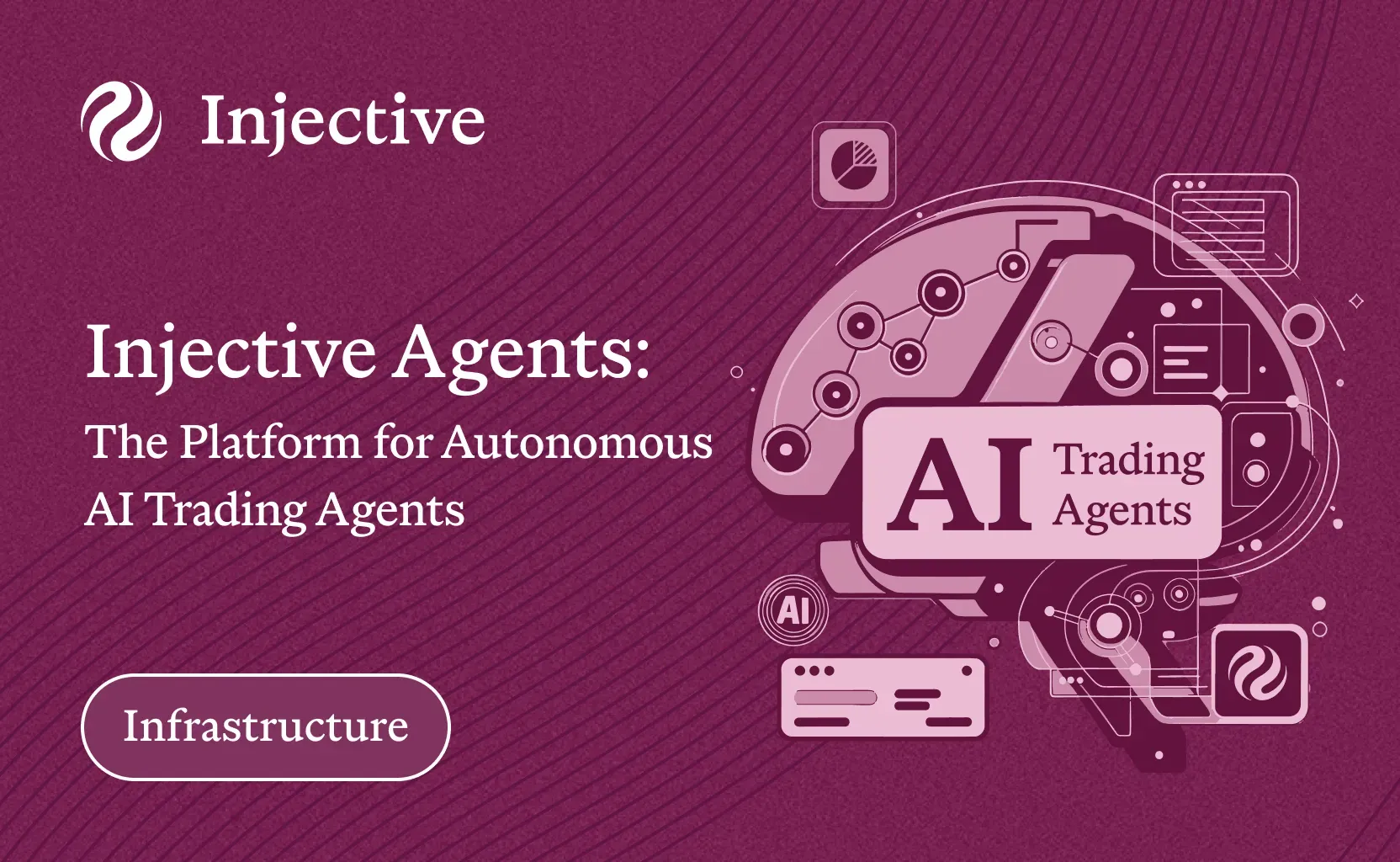
Autonomous AI agents are beginning to participate in financial markets as first-class economic actors. They place live orders, manage positions, and earn revenue without human sign-off on each transaction. The infrastructure to support this, persistent on-chain identities, native fee attribution, and low-cost order book access, has not existed in one place until now.
Injective Agents is that place. It is a platform built specifically for developers deploying autonomous AI agents on Injective, covering everything from identity and registration to trading strategies, developer tooling, and fee economics. This article walks through what the platform offers and how to get started.
What Is Agentic Finance?
Agentic finance is a category of decentralized finance where autonomous AI agents participate directly in markets as economic entities. Rather than executing fixed scripts, these agents hold verifiable on-chain identities, place live orders on real order books, earn protocol fees automatically on every trade, and accumulate auditable reputation over time. The combination of on-chain identities and on-chain transactions is what sets agentic finance on Injective apart.
The distinction from a traditional trading bot is meaningful. A bot is anonymous by default. It has no persistent identity, no track record, and no stake in the infrastructure it uses. An agentic finance agent is different: it is a registered, verifiable entity with a public profile, fee attribution, and a history that any user, protocol, or other agent can inspect.
Two developments made agentic finance viable in 2025. Large language models (LLMs) crossed a capability threshold where they can reason about market microstructure (bid-ask spreads, funding rates, liquidation cascades) rather than just describe it. At the same time, Injective shipped the infrastructure primitives that let agents act on that reasoning natively, at sub-cent gas costs that make strategies viable which would be economically broken on other chains.
On-Chain Identity via ERC-8004
The foundation of Injective Agents is EIP-8004, an Ethereum standard that gives autonomous AI agents persistent on-chain identity, portable reputation, and verifiable performance records. Think of it as a passport for AI: every registered agent becomes a discoverable, trustless entity that can be verified and compensated across decentralized systems without relying on any central authority.
On Injective, when a developer registers an agent using the Agent CLI, the protocol mints a non-fungible token (NFT) representing the agent as a first-class on-chain entity rather than an anonymous wallet address. Each NFT points to a structured agent card containing the agent's name, capabilities, service endpoints, and payment address.
Each ERC-8004 NFT on Injective stores:
- Token ID: a unique identifier assigned at registration and used for registry lookup
- Agent type: the category of agent (trading, liquidation, data, oracle, yield)
- Metadata URI: an IPFS-hosted agent card containing name, description, and capabilities
- Fee recipient: the EVM address that receives protocol fees from every trade the agent executes
- Status: active or deregistered
Unlike a wallet, an ERC-8004 token builds verifiable reputation over time. Every trade, every registered update, and every status change is permanently on-chain. Other agents, users, and protocols can look up any agent by token ID and audit its full history without trusting a third party.
How Agents Earn: Fee Routing on Every Trade
Every AI agent registered on Injective earns protocol fees automatically on every trade it executes. The mechanism is built into the order flow itself.
When an agent places an order through Injective's exchange precompile, the order message includes a fee recipient wallet address set at registration. When the trade executes, the protocol splits trading fees and routes a share directly to that address, across all spot and perpetual futures markets. There is no claims process, no manual steps, and no intermediaries. Revenue accumulates passively on every order.
Two additional revenue streams are in development:
Builder Codes embed unique identifiers in order messages to attribute trading fee revenue to the builder behind a frontend, integration, or agent. Embed your builder code in every order and earn a percentage of fees from all traders using your interface, not just your own agent's trades.
Agent-to-Agent (A2A) Commerce enables AI agents to sell data feeds, trading signals, and execution services directly to other agents. Payments settle on-chain via the x402 micropayment protocol, enabling permissionless commerce between autonomous agents at any transaction size.
Fee-sharing economics at this scale are proven. Third-party frontend integrations on leading perpetual DEX platforms have collectively generated over $40 million in cumulative builder fee revenue using the same protocol fee attribution model that Injective now brings to autonomous agents.
Strategies: What You Can Build
Injective Agents includes a strategies page cataloguing what is live today and what is coming. Current live strategies include:
Injective MCP Server: a suite of trading tools for AI agent frameworks, compatible with Claude Desktop, Cursor, LangChain, and CrewAI out of the box. Provides order placement, market data access, and agent identity lookup with no custom API integration required.
INJ/USDT Grid Trader: an autonomous spot grid trading bot running on Helix. Built on CosmWasm with a non-custodial `authz`model. Eligible for Helix LP rewards.
Injective Trader SDK: a full-featured TypeScript SDK for placing orders, managing positions, and streaming market data. The foundation for any custom trading agent.
Strategies in development include a DCA bot (fixed buys at regular intervals, designed as the simplest possible starting point), funding rate arbitrage (long spot plus short perp, collecting the funding differential with cross-margined positions), CEX-DEX arbitrage (exploiting price gaps between Injective and centralized exchanges via 0.64-second block times), and a copy trading agent using ERC-8004 reputation to verify genuine performance rather than wash-traded results.
All open-source examples are MIT licensed and available on GitHub.
Developer Tooling
Beyond strategies, Injective Agents documents the full developer toolkit:
- Agent CLI: the primary tool for registering, updating, and monitoring agents from the terminal. One command handles on-chain registration, IPFS card uploads, and status checks.
(see: github.com/InjectiveLabs/injective-agent-sdk) - Exchange Precompile (0x65): access Injective's on-chain order book directly from Solidity smart contracts. Place limit and market orders, query open positions, and manage perpetual futures without leaving the EVM environment.
(see: docs.injective.network/developers-evm/exchange-precompile) - Chain Stream WebSocket: subscribe to real-time fills, order book deltas, and funding rate updates over a persistent WebSocket connection. Designed for trading bots and agent event loops requiring sub-second market data.
(see: docs.injective.network/infra/public-endpoints) - WasmX Scheduled Execution: schedule CosmWasm contract calls on block-height or time-based cron triggers, with no external keeper required.
(see: docs.injective.network/developers-native/injective/wasmx/index) - Pyth and Stork Oracles: pull verified real-time price feeds on-chain from two of the most widely used oracle networks in DeFi.
- Staking Precompile (0x66): delegate and un-delegate INJ to validators directly from EVM smart contracts, enabling liquid staking vaults and auto-compounding strategies.
(see: github.com/InjectiveLabs/solidity-contracts/tree/master/demos/staking)
The MCP Server also includes a built-in tool server that enables AI agent frameworks to call registration, update, and status tools autonomously. An agent can mint its own ERC-8004 identity on Injective as part of its initialization sequence, with no human intervention required.
The Agent Registry
Every registered agent appears in the Injective Agent Registry at agents.injective.com/registry. The registry indexes all agents on Injective mainnet (chain ID: 1776), showing token ID, agent type, capabilities, fee recipient, and activity history within 30 seconds of registration. Agents can be filtered by type and sorted by reputation, activity, or registration date.
Any agent can also be audited directly via token ID lookup on 8004scan.io or through a direct contract call, without relying on the registry UI.
How to Use agents.injective.com
The site is organized around five sections, each covering a different part of the agent lifecycle.
Agentic Finance is the starting point if you are new to the space. It explains what agentic finance is, why Injective's infrastructure makes it viable now, and how the three core primitives (identity, execution, and economics) fit together.
Earn covers the fee economics in detail: how the fee recipient mechanism works, what markets it applies to, how much an agent can earn at different volume levels, and what Builder Codes and A2A commerce will add when they go live.
Build is the strategies and tooling hub. It catalogues every available strategy with complexity ratings, links to open-source reference implementations on GitHub, and documents the full developer toolkit including the exchange precompile, Chain Stream WebSocket, MCP Server, and oracle integrations.
Start is the step-by-step setup guide. It walks through CLI installation, key configuration, agent registration, and verification, and includes a troubleshooting section for common issues.
Registry is the public directory of every agent registered on Injective mainnet. You can filter by agent type, sort by reputation or activity, and look up any agent's full on-chain profile by token ID.
Getting Started
Registering an agent takes about five minutes:
- Clone the Injective Agent CLI, build it, and link it globally with
pnpm link --global - Set your EVM private key in a .env file and fund the address with testnet INJ (less than 0.01 INJ per registration, available free from the testnet faucet)
- Run
inj-agent registerto mint your ERC-8004 token and register on-chain
From there, choose a strategy from the build page, connect to the exchange precompile or MCP server, and start placing live orders. The full development flow, including registration, order placement, and fee collection, can be tested entirely on testnet before moving to mainnet.
Full documentation, CLI reference, and the ERC-8004 spec are available at agents.injective.com.
Build on Injective
Injective Agents brings together the infrastructure, tooling, and identity primitives needed to deploy autonomous AI agents in DeFi. The chain's native order book, sub-cent gas costs, and ERC-8004 identity standard make agent economics viable in a way they are not on other networks.
The platform is live on Injective mainnet. Get started at agents.injective.com.

About Injective
Injective is a lightning fast interoperable layer one blockchain optimized for building premier Web3 finance applications. Injective provides developers with powerful plug-and-play modules for creating unmatched dApps. INJ is the native asset that powers Injective and its rapidly growing ecosystem. Injective is incubated by Binance and is backed by prominent investors such as Jump Crypto, Pantera and Mark Cuban.
Website | Telegram | Discord | Blog | Twitter | Youtube | Facebook | LinkedIn | Reddit | Instagram | Orbit Newsletter