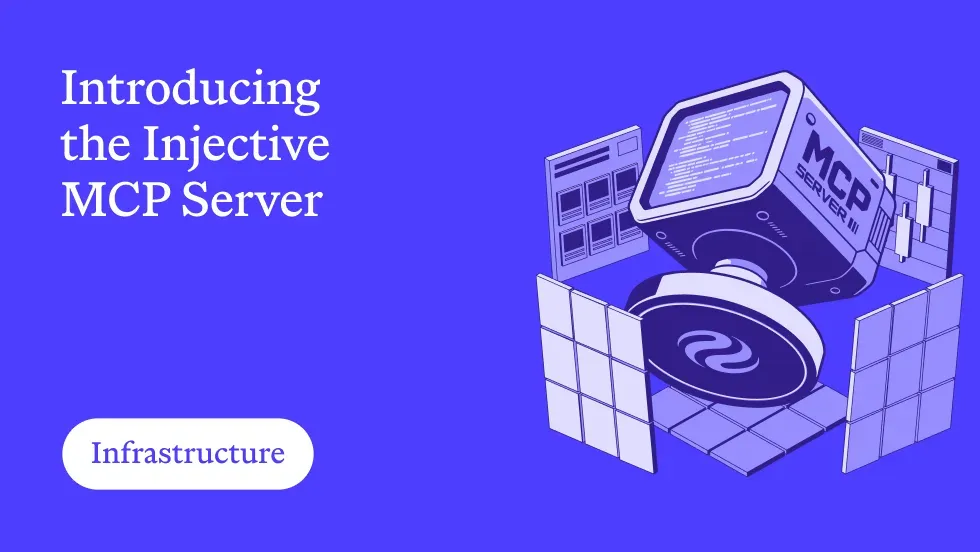
Introducing the Injective MCP Server: Injective Becomes First Blockchain to Let AI Agents Trade Perpetual Futures via Natural Language
The Injective MCP Server is now live and open source, enabling the first full-execution AI trading backend for onchain derivatives. With a groundbreaking Anthropic integration, Injective now turns the entire trading workflow into a conversation.
The way financial applications are built is changing. AI agents are quickly becoming the primary interface between users and onchain protocols, and the infrastructure powering these agents needs to keep pace. The Injective MCP Server is a purpose-built, open-source server that gives AI agents the ability to trade perpetual futures on Injective directly from a natural language conversation.
Injective continues to lead in AI-ready onchain infrastructure. The MCP Server extends this vision by turning Injective's native financial modules into tools that any AI agent can access and compose in real time.
The Injective MCP Server is open source and available now.
GitHub: github.com/InjectiveLabs/mcp-server
From Natural Language to Signed Transaction
"Agents shouldn't need to understand transaction construction to trade onchain. With the MCP Server, any AI agent can go from intent to signed trade in seconds without cumbersome API keys or custom integration logic," said Injective Foundation CEO, Eric Chen.
Building a trading application has traditionally meant weeks of low-level plumbing. API keys, WebSocket connections, order book normalization, fee calculations, transaction signing, reorg handling. All of that before writing a single line of strategy logic.
The Injective MCP Server skips all of it. The server implements the Model Context Protocol (MCP), an open standard for connecting AI agents to external tools and services. Any MCP-compatible agent can interact with Injective's perpetual futures markets in real time, with no custom integration required.
Point Claude, or any compatible AI agent, at the server and the entire trading workflow becomes accessible through conversation. Query active markets and funding rates. Deposit into a subaccount. Open a leveraged position. Monitor P&L. Close a trade. Bridge profits to another chain. Every step from intent to signed, broadcast transaction executes in seconds.
A typical session with the server:
You:    Show me the active BTC and ETH perpetual markets
Claude: [lists markets with oracle prices, funding rates, tick sizes]
You:    Deposit 200 USDT into my trading subaccount
Claude: [broadcasts subaccount deposit, returns tx hash]
You:    Open a $100 long on BTC at 10x leverage
Claude: [fetches oracle price, computes size and margin, builds and signs
        the market order, broadcasts — returns tx hash and fill details]
You:    What's my P&L?
Claude: [queries open positions, shows entry price, mark price, unrealized PnL]
You:    Close it
Claude: [closes position with market order]
The MCP Server is a full trading backend built for agents, not a chatbot wrapper around an existing API.
Architecture and Security
The server ships with 22 tools across six categories, 262 tests, AES-256-GCM key encryption, and cross chain bridging to Ethereum, Base, Arbitrum, Solana, and more. All open source from day one.
Security is built into every layer of the MCP Server. Private keys are stored locally using AES-256-GCM encryption with scrypt key derivation and are never exposed to the AI model. The server runs locally alongside the AI client, communicating via stdio. The model only ever sees wallet addresses and transaction hashes. Keys never leave the user's machine.
Transactions are signed directly with the user's private key using the Injective SDK, with no custodian or intermediary involved. The server supports both MsgBroadcasterWithPk for server-side signing and EIP-712 for MetaMask-based signing in the browser frontend.
The codebase is fully typed TypeScript with 262 tests covering unit behavior and integration against testnet.
Built for Injective's Onchain Orderbook
Perpetual futures on Injective operate on a fully onchain orderbook. There is no off-chain matching engine. Every order, fill, and cancellation is a chain transaction, which means users get true ownership and full transparency. It also means transaction construction is non-trivial. Price and quantity must be quantized to specific tick sizes, margins must be calculated correctly, and prices need to account for oracle slippage.
The MCP Server handles all of this automatically. When an agent is told to open a position, the server fetches the oracle price, computes the appropriate size and margin, quantizes to the correct tick, builds the transaction, signs it, and broadcasts. The user sees a transaction hash and fill details in plain language.
Injective's plug-and-play infrastructure now extends directly to AI agents. The chain's native financial modules become composable with agent logic, and developers never have to manage the underlying complexity themselves.
The Bigger Picture
Trading is just the entry point. The server ships with 22 tools spanning market data, position management, limit orders, token transfers, and cross chain bridging. Agents can compose entire workflows in a single conversation: research a protocol, compare funding rates, size a position in plain English, monitor P&L, and bridge profits to another chain.
But trading is just the first use case. The more important shift is what happens when agents stop being passive users of onchain infrastructure and start building it.
These models already write production code, ship applications, and iterate on products faster than any individual developer. They work around the clock with no downtime. When that capability meets a permissionless financial layer like Injective, the implications go well beyond automated trading. Agents become full participants in the onchain economy. They can deploy protocols, optimize their own smart contracts, grow communities, and generate revenue, all without human intervention at every step.
Consider what this looks like at scale. An agent identifies a gap in onchain derivatives tooling, writes and deploys a new protocol on Injective, attracts users, collects fees, and reinvests those fees into improving the product. Another agent builds a competing protocol. A third builds analytics infrastructure that serves both. The entire cycle of building, using, and iterating on onchain applications begins to run autonomously, with agents on both sides of every transaction and every deployment.
Crypto rails were built for this. Permissionless execution, programmable money, composable contracts, open state. Humans use these systems, but they were always a natural fit for machine intelligence. Onchain infrastructure will increasingly function as the native circuitry of AI, the base layer through which agents transact, coordinate, and build, much the same way biological systems rely on the nervous system to process signals and allocate resources.
Injective, as the blockchain built for finance, is uniquely positioned at the center of this transition. The chain's native financial modules, its fully onchain orderbook, its plug-and-play developer primitives, and its MultiVM environment were designed to power the next generation of financial applications. The MCP Server is the first step in making that infrastructure accessible to agents. What comes next is an onchain economy where the builders, the users, and the infrastructure itself evolve together.
The protocol is open. The tools are composable. The chain is permissionless. Build with it.
Get Started
The Injective MCP Server is open source and available now.
GitHub: github.com/InjectiveLabs/mcp-server

About Injective
Injective is a lightning fast interoperable layer one blockchain optimized for building premier Web3 finance applications. Injective provides developers with powerful plug-and-play modules for creating unmatched dApps. INJ is the native asset that powers Injective and its rapidly growing ecosystem. Injective is incubated by Binance and is backed by prominent investors such as Jump Crypto, Pantera and Mark Cuban.
Website | Telegram | Discord | Blog | Twitter | Youtube | Facebook | LinkedIn | Reddit | Instagram | Orbit Newsletter