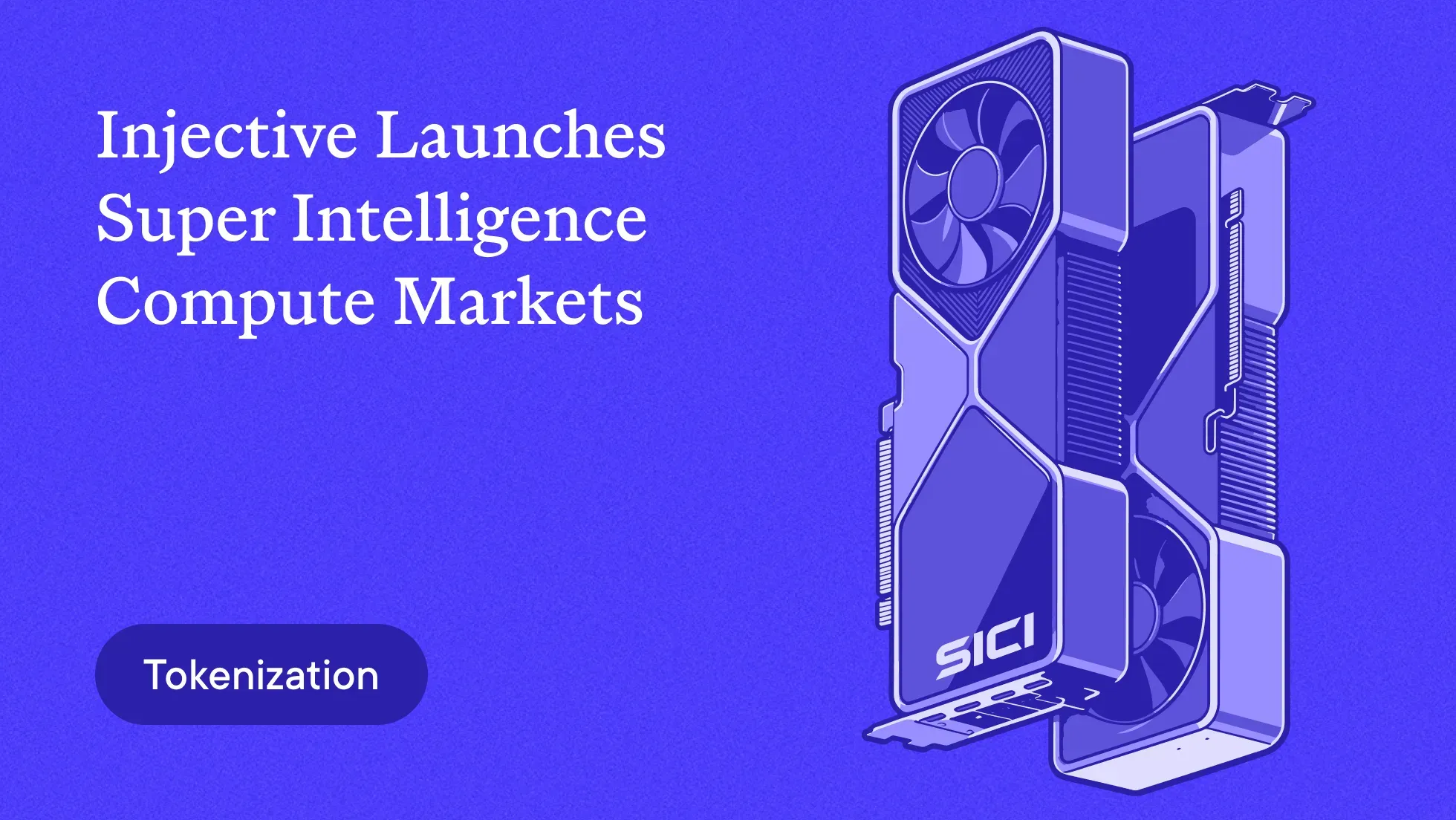
The Super Intelligence Compute Index (SICI) is officially live on Injective. It's an onchain benchmark tracking the rental costs of five Nvidia GPUs, giving traders exposure to the price of compute powering advanced artificial intelligence. SICI launches on mainnet with a perpetual market, tradable with up to 10x leverage We are also set to introduce a brand new onchain finance primitive in the coming days.
Compute is one of the defining bottlenecks in advanced AI. Leading AI labs secure GPU capacity years ahead, while smaller builders compete for what's left. Rental prices fluctuate across providers and hardware generations, yet financial markets for trading this growing asset class remain limited. SICI changes that.
In 2025, Injective put one GPU onchain with the first onchain Nvidia H100 rental market. SICI prices five GPUs in one index, from Nvidia's newest Blackwell chips to the consumer cards running inference on developers' desks.
What SICI Tracks
SICI tracks the hourly rental price of five Nvidia GPUs at fixed weights, built on the LO:TECH Compute Index.
GPU | Weight | Compute Stack Description |
| Nvidia H100 SXM 80GB | 40% | The workhorse for training and serving large models |
| Nvidia B200 | 25% | High-performance Blackwell-generation datacenter GPU used for large-scale AI training and inference |
| Nvidia H200 | 15% | Hopper with more memory, built for bigger models and long-context inference |
| Nvidia A100 SXM 80GB | 10% | Previous generation, still rented widely for fine-tuning and inference |
| Nvidia GeForce RTX 4090 | 10% | Consumer card used for low-cost inference and open-source models |
The H100 carries the largest weight, so its rental price moves SICI more than any other chip. The B200 and H200 add the newer, higher-memory capacity that frontier labs are racing to secure.
Why GPU Compute Needs Its Own Markets
The demand for AI compute is accelerating. According to the International Energy Agency, electricity consumption at AI-focused data centers surged 50% in 2025, while the world's largest technology companies are committing hundreds of billions of dollars to expanding AI infrastructure.
At the center of this growth are GPUs. Every new frontier model, AI application, and autonomous agent requires compute to train, operate, and scale. As AI adoption expands, GPU rental capacity is becoming an increasingly important economic resource, with prices shaped by demand, hardware availability, and competition among cloud providers.
Yet the financial markets surrounding compute remain underdeveloped. GPU rental prices vary across providers and hardware generations, making it difficult for market participants to manage their exposure. AI developers face rising operating costs when compute becomes scarce, while GPU providers face declining rental revenues when prices fall.
SICI introduces a new way to participate in this emerging market. By bringing a diversified benchmark of GPU rental prices onchain, it enables traders to take positions on compute prices while creating new opportunities for AI developers and infrastructure providers to hedge their economic exposure.
As AI infrastructure becomes a larger part of the global economy, markets that allow participants to price and manage compute risk will become increasingly important.
Why a 4090 In The Compute Stack
A gaming card in a compute index looks odd until you follow the demand. Frontier models train on datacenter GPUs like the B200 and H100, but running models is a different job. Developers serve open-source models, fine-tune small ones, and run agents on cards like the 4090 every day, and they rent those cards by the hour too.
Including the 4090 lets SICI price the whole compute curve. When frontier training demand spikes, the B200 and H100 legs move. When inference spreads to smaller builders, the 4090 leg picks it up. One market reads across the demand spectrum.
How SICI is Priced
SICI is built and priced by LO:TECH, a London-based capital markets firm that runs market making and institutional market data across 80+ venues, like Coinbase, Kraken, and OKX.
LO:TECH trades on the same data it provides, so getting the price right is its business. It captures data directly at the venue and stores more than 23 billion rows of market data every day.
Each GPU enters at its LO:TECH reference price, a level in US dollars per GPU-hour drawn from compute marketplaces, where many sellers set the price together. On-demand and spot listings are pooled. Each marketplace counts once per chip, and every observation passes validation and outlier controls before it enters.
Each chip is rebased to 100 at the July 22, 2026 daily fixing, and the five levels are combined at their fixed weights. The published index is the trailing seven-day average of that hourly basket, quoted in index points. LO:TECH strikes it on the hour, every hour, UTC, and the 19:00 UTC print is the daily fixing.
Fixed weights mean you always know what you're trading. Every move in SICI traces back to a move in one or more of the five rental rates, and any print can be regenerated from archived data with an identical result. Weights hold for each methodology version, and a change ships as a new version beside the old one, never over the live index.
From One GPU to a Full Index
Injective has been building toward SICI since January 2025, when it launched AIX, its first index perpetual. AIX put AI tokens like Bittensor and Virtuals in the same market as AI equities like Nvidia and TSMC.
That August came the H100 GPU market, built with Squaretower. For the first time, anyone could trade the hourly rental price of an H100 onchain.
SICI brings those two ideas together. It takes the index structure that AIX proved out, applies it to compute pricing, and widens the basket from one GPU to five.
Where SICI Fits on Injective
Injective keeps listing markets that used to be out of reach. In October 2025, pre-IPO perpetuals brought OpenAI, SpaceX, Anthropic, and Perplexity onchain, with data from Caplight and SEDA. Traders can now access price exposure to leading private AI companies and the GPU compute powering the broader industry on the same chain.
SICI adds the other side of that trade. SI’s most valuable private companies and the compute they run on now trade on the same chain.
That range is the norm on Injective now. 47% of Injective's active perpetual markets are tied to real-world assets, with 135 RWAs spanning equities, FX, commodities, indices, and pre-IPO names.
How to Trade and Build With SICI
The SICI perpetual is live on Injective mainnet and available for integration across ecosystem dApps, with up to 10x leverage and USDC as the margin asset.
Both markets are open for integration. Any dApp across the Injective ecosystem can plug in the SICI perpetual markets and offer them to its own users without building a market from scratch.
GPU rental prices have always sat with cloud providers and data vendors, out of reach for anyone who wanted exposure to them. SICI changes that. Anyone with an onchain wallet can now access the hourly cost of the GPUs powering SI, trading now on Injective.