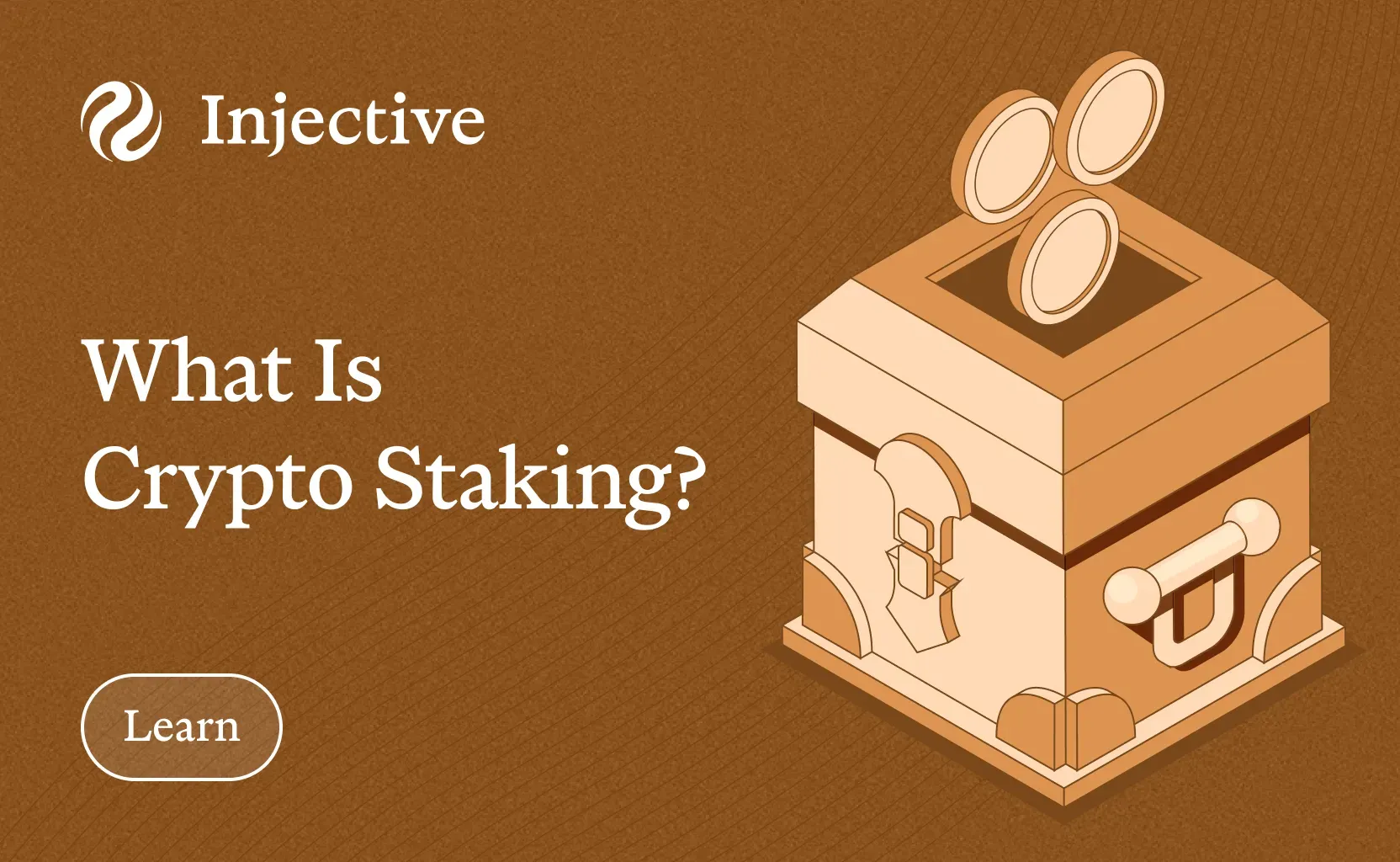
Crypto staking is the process of locking up cryptocurrency to help secure a blockchain network and earn rewards in return. Staking is most commonly associated with proof-of-stake blockchains, where network security and transaction validation are performed by participants who commit capital rather than computing power.
Unlike mining, which relies on expensive hardware and high energy consumption, staking allows users to participate in network security simply by holding and committing tokens. In exchange for this contribution, stakers earn rewards that are typically paid in the same asset they stake.
For beginners, crypto staking is often seen as one of the more accessible ways to earn yield in the crypto ecosystem. It does not require active trading, complex strategies, or constant monitoring of price movements. However, staking is not risk-free, and understanding how it works is essential before committing funds.
On Injective, staking plays a central role in network security and governance. Injective’s proof-of-stake design, documented in the Injective Docs, enables fast finality, low fees, and an incentive structure that aligns validators and token holders with the long-term health of the network.
How Crypto Staking Works
Crypto staking relies on proof-of-stake consensus, a mechanism that replaces miners with validators. Validators are responsible for proposing blocks, validating transactions, and maintaining network integrity. To become a validator, participants must stake tokens as economic collateral, which can be reduced if they behave maliciously or fail to meet network requirements.
Token holders who do not run validator infrastructure themselves can still participate in staking by delegating their tokens to validators. Delegators share in the rewards earned by validators while helping distribute stake across the network, improving decentralization.
Step-by-step flow
- Token commitment: Tokens are locked into a staking contract or delegated to a validator.
- Validation process: Validators use staked tokens to participate in block production and consensus.
- Reward distribution: Rewards are generated through inflation, transaction fees, or both, and distributed to validators and delegators.
- Unstaking period: Tokens typically go through an unbonding period before they can be withdrawn or transferred.
What users actually interact with
Most users interact with staking through wallets or dashboards that abstract validator mechanics. Users usually select a validator, choose an amount to stake, and monitor rewards over time without needing to understand the underlying consensus logic.
Technical constraints
Staking systems include several important constraints:
- Unbonding periods that limit liquidity
- Slashing conditions for validator misbehavior
- Validator uptime and performance variability
- Network governance rules that can change over time
These constraints affect both risk and reward and should be understood before staking.
Why Crypto Staking Is Different From Yield Farming and Mining
Crypto staking is often compared to yield farming and mining, but these activities serve different purposes.
Mining secures proof-of-work networks through computational effort and energy consumption. Yield farming typically involves providing liquidity to DeFi protocols in exchange for incentives, often with smart contract risk and variable returns.
Staking, by contrast, directly supports network security and consensus at the protocol level. Rewards are generally more predictable, but capital is often locked for a period of time.
Key differences include:
- Staking: Secures the network and earns protocol-level rewards
- Yield farming: Provides liquidity and earns application-level incentives
- Mining: Secures networks through computation and hardware investment
Key Properties of Crypto Staking
Network security
Staking aligns economic incentives with network health. Validators who act maliciously or fail to meet requirements risk losing a portion of their staked tokens through slashing.
Predictable rewards
Staking rewards are often more predictable than DeFi yield strategies, though they vary based on network parameters, validator performance, and overall participation rates.
Capital lockup
Most staking systems require tokens to be locked for a period of time. This reduces liquidity in exchange for rewards and introduces opportunity cost.
Who typically uses staking
Crypto staking is commonly used by:
- Long-term token holders
- Network supporters and community members
- Validators and infrastructure providers
- Users seeking lower-risk yield compared to active DeFi strategies
Main Use Cases of Crypto Staking
Earning passive rewards
Staking allows token holders to earn rewards without active trading. This is often attractive to long-term investors who plan to hold assets regardless of short-term price movements.
Supporting network security
By staking tokens, participants contribute directly to the security and decentralization of the network, helping prevent attacks and ensuring reliable operation.
Governance participation
Many proof-of-stake networks grant governance rights to stakers, allowing them to vote on protocol upgrades, parameter changes, and ecosystem decisions.
Numerical Walkthrough: Simple Staking Example
Assume a user stakes 1,000 tokens on a network offering an annual staking reward rate of 8 percent. Over one year, the user would earn approximately 80 tokens before validator commissions and compounding effects.
If the network has a 21-day unbonding period, the user cannot immediately withdraw tokens once unstaking begins. During this time, the tokens do not earn rewards and remain exposed to price volatility.
This example highlights the trade-off between earning predictable rewards and sacrificing liquidity.
Common Beginner Mistakes With Crypto Staking
Beginners often underestimate the importance of understanding staking mechanics.
Common mistakes include:
- Delegating to validators without researching performance or commission rates
- Ignoring slashing risks and validator uptime
- Forgetting about unbonding periods when liquidity is needed
- Treating staking rewards as guaranteed returns
Avoiding these mistakes requires basic research and realistic expectations.
Who Crypto Staking Is Not Suitable For
Staking may not be suitable for every participant.
It may be a poor fit for:
- Users who require immediate liquidity
- Short-term traders focused on frequent position changes
- Participants unwilling to research validators
- Those uncomfortable with protocol-level risk
Understanding personal risk tolerance is critical before staking.
Why Crypto Staking Matters Today
As crypto networks mature, sustainable security models have become increasingly important. Proof-of-stake systems rely on staking to align incentives, reduce energy consumption, and decentralize validation.
Staking matters today because it:
- Secures modern blockchain networks
- Encourages long-term participation
- Reduces reliance on energy-intensive mining
- Enables onchain governance and community ownership
Risks and Challenges
Staking introduces several risks that users should understand:
- Slashing due to validator misbehavior
- Illiquidity during unbonding periods
- Changes in reward rates over time
- Market volatility affecting the value of staked assets
These risks mean staking should be viewed as a medium- to long-term commitment.
Crypto Staking on Injective
Injective uses proof-of-stake consensus to secure the network and power onchain governance. Validators are responsible for proposing blocks, validating transactions, and maintaining the integrity of the chain, while token holders can delegate stake to those validators to participate indirectly.
Token holders who stake INJ help secure the network while earning protocol-level rewards. Delegation also plays an important role in decentralization, as spreading stake across multiple validators reduces concentration risk and improves network resilience.
Injective’s fast finality, low fees, and validator incentive structure are designed to balance performance, security, and accessibility for both validators and delegators.
Liquid Staking and Staking Derivatives
Some ecosystems support liquid staking, which allows users to stake tokens while receiving a liquid representation of their staked position. These liquid staking tokens can sometimes be used in other DeFi applications while still earning staking rewards.
Liquid staking introduces additional flexibility, but it also adds complexity and risk. Users must evaluate smart contract risk, liquidity conditions, and protocol design when considering liquid staking options.
On Injective, staking is primarily focused on securing the core network, but understanding liquid staking concepts helps users compare staking with other yield-generating approaches across DeFi.
How to Choose a Validator
Choosing a validator is one of the most important decisions a staker makes.
Key factors to consider include:
- Validator uptime and historical performance
- Commission rates and fee structure
- Self-bonded stake and alignment of incentives
- Transparency, reputation, and community involvement
Delegating to multiple validators can help reduce risk and improve decentralization.
Staking Rewards and Taxes
In many jurisdictions, staking rewards may be considered taxable income. Tax treatment varies widely depending on local regulations and how rewards are classified.
Stakers should keep records of rewards received, including dates and values, and consult local tax guidance or professionals. Understanding potential tax obligations is an important but often overlooked part of staking.
Crypto Staking vs Lending
Staking is sometimes compared to crypto lending, but the two serve different purposes.
Staking supports network security and consensus, while lending involves providing assets to borrowers in exchange for interest. Lending typically introduces counterparty or smart contract risk, whereas staking risk is tied to protocol rules and validator behavior.
Understanding these differences helps users choose the approach that best aligns with their risk tolerance and goals.
How to Get Started With Crypto Staking
Prerequisites
- A compatible wallet
- INJ tokens or another proof-of-stake asset
- Basic understanding of staking mechanics
Practical learning path
- Learn Injective fundamentals and proof-of-stake concepts
- Review available validators and their performance metrics
- Delegate a small amount of tokens initially
- Monitor rewards, commissions, and validator behavior
- Understand unbonding rules before unstaking
FAQ
What is crypto staking in simple terms?
Crypto staking involves locking tokens to help secure a blockchain network and earn rewards in return.
Is crypto staking safe?
Staking carries risk, including slashing, validator failure, and market volatility.
Can you lose money while staking?
Yes. Token prices can fall, and slashing events can reduce staked balances.
How long are tokens locked when staking?
Lockup periods vary by network and typically range from days to weeks.
Does staking guarantee returns?
No. Rewards depend on network rules, validator performance, and overall participation.
Can staked tokens be used elsewhere?
In most cases, staked tokens cannot be transferred or used until they are unstaked and the unbonding period has completed.
Is staking the same as earning interest?
No. Staking rewards come from protocol incentives rather than lending activity, and they carry different risks and assumptions.