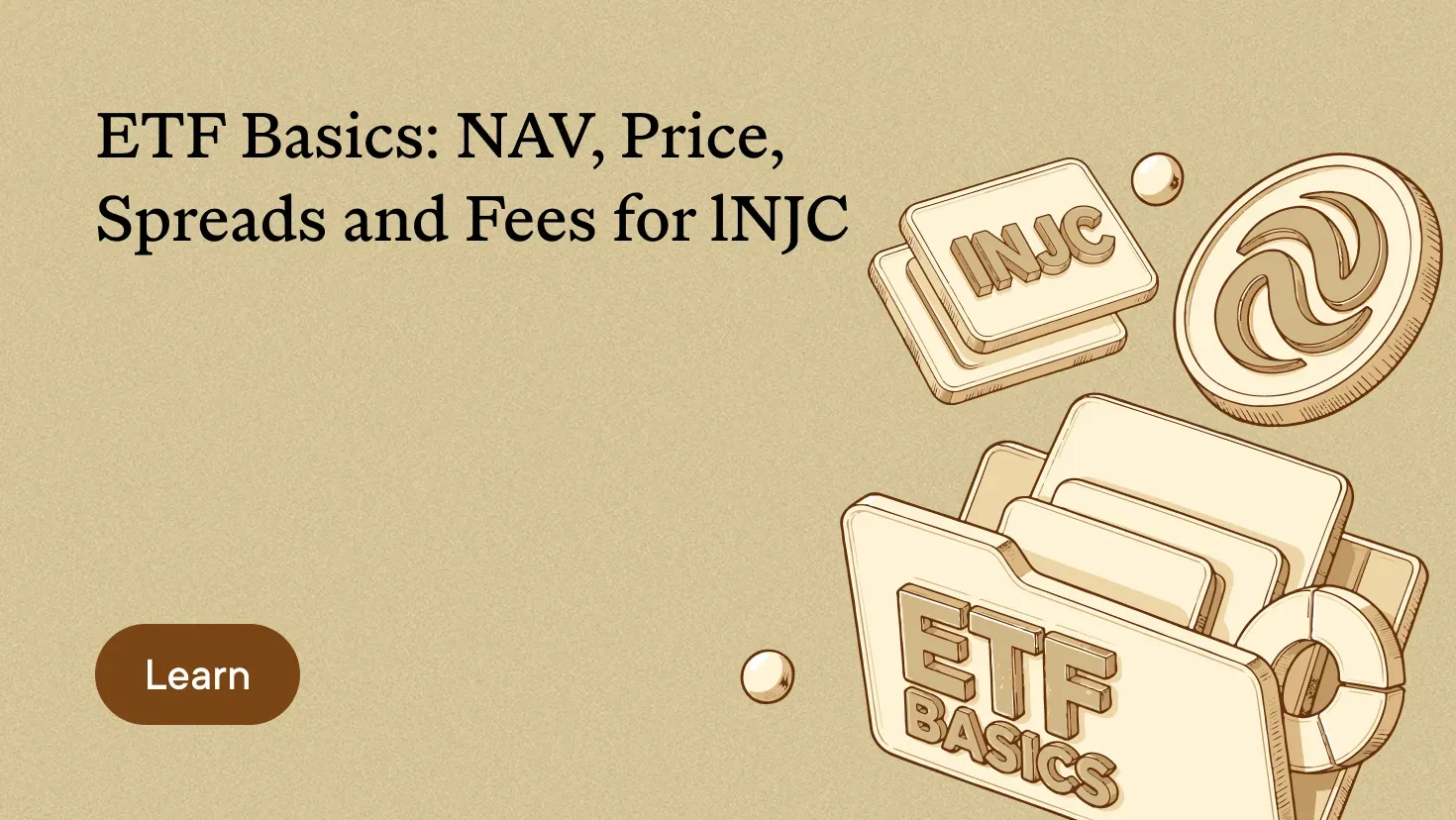
An ETF lets you own a slice of a fund through the same brokerage account you'd use for stocks. INJC, the Canary Staked INJ ETF, is designed to hold INJ, the native asset of Injective, a blockchain built for finance. Once it trades, shares will be bought and sold in dollars, with no crypto wallet needed. Availability of shares will depend on your broker and account type.
If this is your first ETF, or your first crypto ETF, the vocabulary is the hard part. A handful of terms decide what you pay and what you end up owning. Here's what each one means before you look at INJC. The SEC's investor bulletin on ETFs covers the same ground in more depth.
NAV, the Value Behind Each Share
NAV stands for net asset value. It's the value of everything the fund holds, minus what it owes, divided by the number of shares outstanding.
INJC holds INJ, so its NAV moves with the price of INJ. The fund calculates NAV once each trading day using a CoinDesk Injective rate, a 60-minute time-weighted average of INJ prices from major trading platforms, set at 4 p.m. ET.
Think of NAV as the fund's own price tag for what it holds. The price you pay for a share is something else, and it comes next.
Market Price and Why It Drifts
Market price is what INJC shares trade for on the exchange during the day. Buyers and sellers set it, one trade at a time.
Market price usually stays close to NAV, but the two can separate. Shares that trade above NAV trade at a premium. Shares that trade below it trade at a discount. Gaps can widen when markets move fast.
Large firms called authorized participants help pull the two back together. More on them below.
Bid, Ask and the Spread
Every trade has two sides. The bid is the highest price a buyer will pay right now. The ask is the lowest price a seller will take. The gap between them is the bid-ask spread, and it's a real trading cost.
The SEC uses this example. An ETF has a bid of $59.50 and an ask of $60.00, so the spread is 50 cents. Buy 200 shares at the ask, sell them right away at the bid, and you've lost $100 without the price moving at all. Those are illustrative numbers, not INJC prices.
Funds that trade more often tend to have tighter spreads. A fund's spread can change as its trading volume changes.
Market Orders vs. Limit Orders
How you place an order changes how much the spread, or a premium, can cost you.
A market order trades right away at the best price available. It's fast. You give up control of the price, though, and in a wide or fast market you can pay more than you expected.
A limit order sets your price. A buy limit order fills only at your price or lower, and a sell limit order fills only at your price or higher. If the market never reaches your price, the order doesn't fill.
With a new fund, or any time prices are jumping around, a limit order keeps you in charge of what you pay.
Fees and the Expense Ratio
An expense ratio is a fund's annual fee, shown as a percentage of fund assets. You never get a bill for it. The fund takes it from its assets over time, which trims NAV a little each day.
Canary calls INJC's annual fee a sponsor fee. Staking fees are separate. They come out of staking rewards and are shared by the sponsor, the staking providers and the custodian before any net rewards reach NAV. Your broker may also charge a commission, and every trade carries the spread.
INJC's exact fees are listed in the prospectus, on the fund page at canaryetfs.com/INJC.
Market Hours
INJ trades around the clock, every day of the year. INJC will trade only when the exchange is open, on weekdays during market hours.
That gap matters more than most first-time buyers expect. If INJ moves overnight or over a weekend, INJC can't react until the market opens. The share price catches up at the open, sometimes in a single jump.
Creations and Redemptions
New INJC shares come from large institutions called authorized participants. They create and redeem shares directly with the fund, in blocks of 10,000 shares.
When the market price drifts above NAV, authorized participants can create new shares and sell them, which pushes the price back down. When it drifts below NAV, they can redeem shares, which pushes it back up. That process is what usually keeps an ETF's price close to its NAV.
Individual investors never deal with the fund directly. You buy and sell shares on the exchange, the same way you'd trade a stock.
FAQ
Do I Own INJ If I Buy INJC?
No. You own shares of a fund, and the fund holds the INJ. You can't move INJC shares to a crypto wallet, stake them yourself or vote on Injective governance. Our INJ vs. INJC guide lays out several key differences.
Why Doesn't INJC Match INJ's Price?
One INJC share isn't one INJ, so the dollar prices won't line up. Compare percentage moves instead. Even then, the two can drift apart. INJC trades only during market hours, its shares can trade at a premium or discount, and fees reduce the INJ behind each share while any net staking rewards add some back.
Where Do I Find INJC's Fees?
In the prospectus, which lives on Canary's fund page at canaryetfs.com/INJC. It lists the sponsor fee, explains how staking fees work and covers the fund's risks.

About Injective
Injective is the first blockchain purpose-built for finance, enabling users, institutions, and AI agents to trade, tokenize, and transact at scale. Proudly made in America, Injective provides foundational blockchain infrastructure for global markets, with embedded financial primitives spanning stablecoins, real-world assets, payments, and programmable perpetuals through a unified onchain engine. Injective is used by Fortune 500 companies, banks, fintechs, and governments to power an open economy where any asset can be accessed anytime, from anywhere. Builders can deploy across multiple virtual machines like WASM and EVM, connect to native financial modules, and launch markets with deep liquidity from day one. INJ is the native token powering the rapidly growing Injective ecosystem and the new internet economy.
Website | Telegram | Discord | Blog | Twitter/X | Youtube | Facebook | LinkedIn | Reddit | Instagram | Orbit Newsletter