This paper provides a comprehensive analysis of the token economic design of Injective’s native asset, INJ. Herein, the token’s diverse utilities, supply mechanics, and expansive token burn system are detailed in full. Additionally, the implications and contents of the INJ 3.0 tokenomics upgrade are comprehensively outlined. The paper culminates in a direct exposition on how INJ design components engineer an environment conducive to perpetuating deflationary characteristics.
Legal Disclaimer: This Tokenomics Paper is not an offer to sell, or the solicitation of an offer to buy, INJ. This Tokenomics Paper is not financial or investment advice. Injective Research is publishing this Tokenomics Paper solely for informational purposes for the benefit of the Injective community. Any statements about future events may prove incorrect and are subject to change without notice or update to this Tokenomics Paper.
Since its inception, INJ has been governed by the Injective community, overseeing all parameters of the chain. Throughout this period, the token economic design has evolved, introducing key innovations and upgrades aimed at creating an optimal environment for both builders and users alike. A major hallmark of this evolution was the implementation of a unique burn mechanism, establishing a deflationary design framework that scales with ecosystem growth. Participation in this system has continually expanded with subsequent upgrades, culminating in the 2024 approval of IIP-392, commonly known as INJ 3.0.1
To fully understand the impact of these tokenomic upgrades, it is essential to first present the complete economic design of INJ. As such, this paper aims to inform readers from all backgrounds about each aspect of INJ and the distinct features that set it apart from other assets in the cryptocurrency industry.
1 What is INJ?
INJ is the native asset powering Injective and its broader ecosystem. Each component of INJ is deliberately engineered to cultivate a thriving Web3 ecosystem. As the native asset of the blockchain, INJ plays a central role in facilitating various operations on Injective. Integral to Injective’s custom implementation of the Tendermint Proof-of-Stake (PoS) consensus framework, INJ is crucial for securing the network through staking.2 Additionally, INJ functions as Injective’s governance token and serves as a means of exchange within the broader Injective ecosystem. Notably, INJ distinguishes itself from other native assets on PoS chains by leveraging core Injective modules to engineer deflationary characteristics through an innovative burn and a dynamic supply mechanism.
1.1 Utility
INJ possesses multiple utilities, including use as a medium of exchange, staking, and governance.
Medium of Exchange: INJ is used as the default asset to facilitate the purchase and sale of goods and services between parties on the blockchain. Common examples of this are paying for transaction fees (gas), buying/selling NFTs, paying for trading fees, or depositing the asset as collateral.
While most goods and services can be denominated in any asset, all transaction fees incurred on Injective are paid in INJ. Additionally, all protocol revenue generated by applications leveraging Injective’s shared liquidity layer via the exchange module is accumulated in INJ.3 Details regarding this feature are further elucidated in Section 2.
Security & Staking: Injective is secured via staking, which is an essential use case for INJ. Validators and delegators can freely participate in the Injective network via staking. Validators operate nodes on Injective, and delegators can assign INJ to a particular node of choice. Staked INJ enables a robust decentralized environment in which security is ensured via penalty and reward systems.
A validator’s staked INJ is subject to slashing in the event of malicious behavior or failure to effectively fulfill responsibilities.4 Additionally, INJ is used to reward validators for participation in transaction validation and block creation. Rewards for validators comprise newly minted INJ (block rewards) and a portion of the associated transaction fees.
Holders of INJ may also participate in staking without necessarily having to operate a node to earn a share of validator rewards. To do so, users delegate INJ to validator(s), which can be done through supported browser wallets, or directly through the Injective Hub. In return for locking up INJ, users earn a share of the validator’s INJ rewards, less the fee charged by the selected validator (commission), distributed pro rata. A user’s staked INJ is also subject to slashing in the event the validator delegated to incurs a slashing event. This ensures that both validators and delegators are aligned in contributing to the overall security of the network.
Beyond securing the Injective chain, INJ also extends its security serviceability to the broader ecosystem through Electro Chains. These Injective-based rollups offer a myriad of technical advantages, such as supporting multiple virtual machines as seen with inEVM.5 Since these rollups settle to Injective, INJ powers the foundational security layer for these networks. This interconnected security framework underscores the pivotal role of INJ in maintaining the integrity and robustness of not only the Injective network, but also the diverse ecosystem of Electro Chains.
Governance: INJ is utilized for community led governance across all parameters of the chain. Injective uniquely has a permissioning layer for smart contract uploads as well, meaning that the community of stakers must vote in order to instantiate a smart contract on mainnet. This empowers the community to directly govern all parameters of Injective as a whole.
For governance, INJ is used for proposal creation and token-weighted voting on active proposals.6 As a spam deterrent, Injective requires a minimum deposit, made in INJ, for the proposal to move on to the voting stage. This deposit threshold can either be met entirely by the proposer, or cumulatively by other users contributing INJ to the proposal deposit. If the minimum deposit amount is not reached by the time the maximum deposit period elapses, the proposal will be automatically rejected, and the deposit(s) burned. Additionally, if the proposal does not pass upon voting period expiry, the proposal deposit is burned.
Proposal voting occurs during a preset voting period, which is set via governance and invariably applied to all governance votes. During the voting process, only staked INJ is eligible to participate in voting. Hence, only validators and delegators can vote on active proposals. Voting power is token-weighted, meaning that 1 INJ equals 1 vote. Delegators are not required to actively participate in governance to maintain their status. However, they have the option to vote directly on proposals. If a delegator does not vote, their voting power will automatically be inherited by the validator to whom they have delegated, for that specific voting event.
2 Mechanics
The functional diversity of INJ is notable, but it is the underlying mechanics that distinguish its architecture from other native crypto assets. Injective incorporates carefully engineered systems that interact symbiotically to confer deflationary properties unto the asset. This interaction is critical for maintaining the economic stability and long-term viability of the asset within the Web3 ecosystem. To this end, the platform employs a dynamic supply mechanism and a novel Burn Auction system.
2.1 Supply Dynamics
Mint Module Injective leverages its mint module to allow for flexible supply parameters as a means to achieve a desired staked supply on the network.7 The Supply Rate automatically adjusts on a block-by-block basis, calculated based on the network’s targeted bonded-stake ratio (Goal Bonded Percentage), Supply Rate Change parameter, lower/upper bounds on token Supply Rate, and Blocks Per Year. As a result, this framework is commonly referred to as the “Moving Change Rate Mechanism.”
The new Supply Rate (SRnew) based on the Actual Bonded Percentage (BPactual) relative to the Goal Bonded Percentage (BPgoal) can be described by the following piecewise function:

where:
- SR is the current Supply Rate.
- SRC is the Supply Rate Change parameter.
- SRupper and SRlower are the upper and lower bounds of the Supply Rate, respectively.
- BPgoal and BPactual are the goal and actual bonded percentages, respectively.
- Blocks Per Year is the number of blocks per year.
This process can be described in plain language, operating in the following manner: •
- If the Actual Bonded Percentage is below the Goal Bonded Percentage, the Supply Rate will increase by an amount proportional to the deviation from the Goal Bonded Percentage but will not exceed the upper bound of the Supply Rate.
- If the Goal Bonded Percentage is maintained, then the Supply Rate will remain constant.
- If the Actual Bonded Percentage exceeds the Goal Bonded Percentage, the Supply Rate will decrease by an amount proportional to the deviation from the Goal Bonded Percentage but will not go below the lower bound of the Supply Rate.
The Moving Change Rate Mechanism is designed to engineer network activity that is responsive and adaptable, ensuring that the network consistently meets its targeted Goal Bonded Percentage. When more INJ is minted per block as the block reward, participants are incentivized to stake more INJ to benefit from increased rewards. Conversely, when the block reward decreases, stakers are incentivized to unbond staked INJ due to decreased rewards. The utilization of this mechanism, with its block-by-block adjustments, enables a programmatically controlled supply dynamic that relies on objective economic indicators as inputs, thereby promoting a more sustainable and stable ecosystem.
2.2 Deflationary Mechanism
The complete versatility of INJ is realized through a combination of mechanisms which operate in tandem. Building on Injective’s innovative approach to supply dynamics, the asset is positioned to exhibit deflationary properties through a well-engineered system designed to remove INJ from circulation. This process is facilitated by Injective’s novel Burn Auction system, which effectively reduces the total supply.
Held regularly, the Burn Auction invites participants to bid on a basket of tokens accumulated from a portion of the revenue generated by participating applications and direct contributions from individual users. The auction operates as an English Auction, where bids are placed using INJ.8 The highest bidder receives the entire basket of assets at the auction’s expiry. The winning INJ bid is then burned, removing it from the total token supply.
The Burn Auction is made possible by two modules that are native to Injective,
Exchange Module: The
The design feature that is key to the Burn Auction is the built-in revenue sharing structure for applications employing the
Auction Module The
2.3 Dynamic Economic Architecture
The resulting economic architecture is synergistic in nature, integrating dynamic supply adjustments with a growth driven token burn mechanism. The mint module adjusts INJ supply in real-time, increasing or decreasing minting rates based on the network’s bonded-stake ratio. This ensures the supply aligns with actual demand and network security needs.
Concurrently, the Burn Auction acts as a deflationary mechanism by periodically removing INJ from circulation. This counters the supply rate and scales in magnitude with ecosystem growth, effectively fostering a healthy economic environment that incentivizes participation. Together, these mechanisms form an economic architecture that ensures the long-term stability and viability of the Injective ecosystem.
3 Genesis Distribution & Vesting
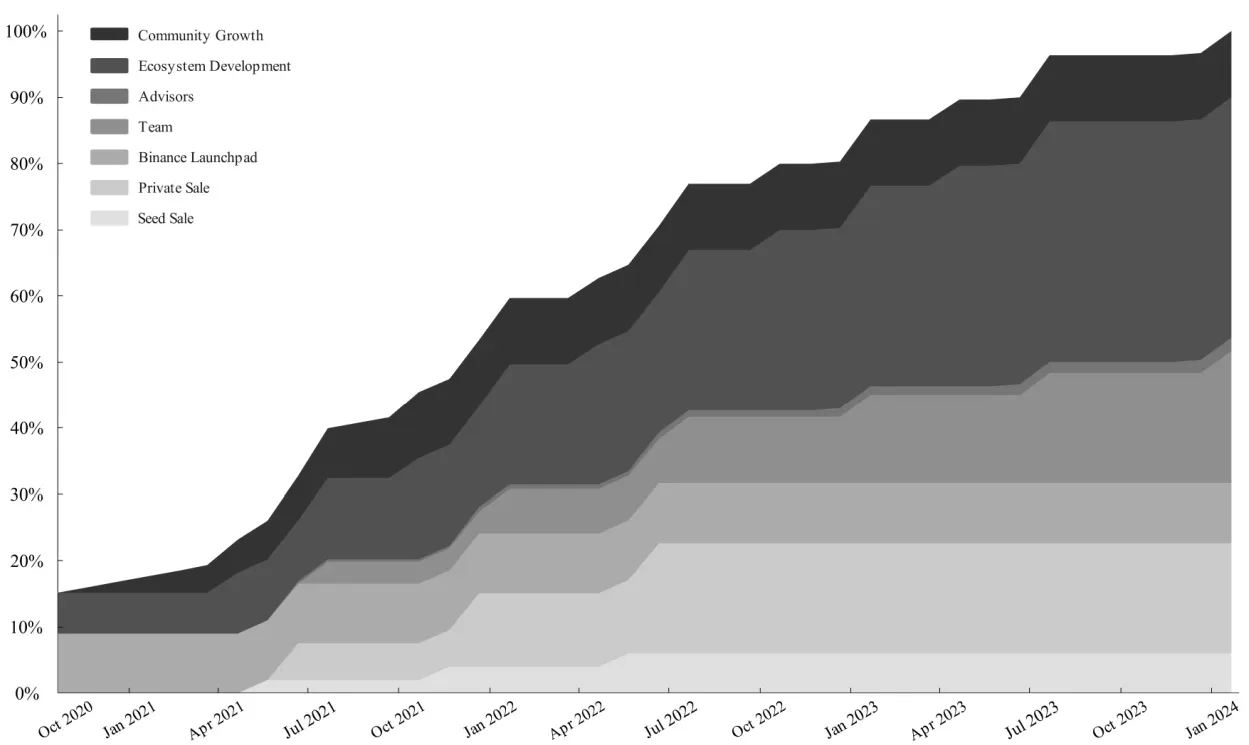
The INJ token generation event (TGE) occurred on October 21, 2020, and had an initial supply of 100,000,000 INJ.
3.1 Genesis Distribution
Category | Percentage |
Seed Sale | 6% |
Private Sale | 16.67% |
Binance Launchpad Sale | 9% |
Team | 20% |
Advisors | 2% |
Ecosystem Development | 36.33% |
Community Growth | 10% |
3.2 Genesis Vesting Schedules
Category | TGE Unlock | Cliff | Summary |
Seed Sale | 0% | 7 months | 33.3% bi-annually post-cliff |
Private Sale | 0% | 8 months | 33.3% bi-annually post-cliff |
Binance Launchpad Sale | 100% | None | Immediate full unlock at TGE |
Team | 0% | 9 months | 16.7% semiannually post-cliff |
Advisors | 0% | 8 months | 16.7% semiannually post-cliff |
Ecosystem Development | 17% | 6 months | 8.30% quarterly post-clif |
Community Growth | 0% | 1 month | 8.33% monthly post-clif |
Total | 15.18M INJ | - | Full unlock by Jan 2024 |
4 Notable Upgrades and Parameters
Sections 1-3 detail the token economic design of INJ at a fundamental-level. This section seeks to elaborate on notable INJ token economic upgrades, parameters, and details. Moreover, INJ 3.0, released in April 2024, is examined in greater detail. Herein, date-specific details and data are presented in an effort to more effectively contextualize the evolution of INJ and the resulting implications.
4.1 Significant Events and Relevant Details
Completion of Genesis Supply Unlock: As of January 2024, the entire initial supply of INJ has been fully unlocked. The initial distribution, detailed in Table 1, followed a structured release schedule across allocation categories, as detailed in Table 2.
The completion of this unlocking process marks a significant milestone in the token’s lifecycle, ensuring that all planned allocations have been distributed according to the predefined schedule. This full unlock allows for the creation of a truly decentralized ecosystem in which network participation is fully open and accessible to all.
Burn Auction INJ 2.0, released in 2023, made it possible for any application to contribute to the Auction Fund, not just those using the
As of May 2024, over 5,920,000 INJ (∼$154,000,000) has been removed from the total token supply through the Burn Auction. The Burn Auction occurs weekly, ending at 9:00 UTC-4:00. Participation can be conducted via the Injective Hub or direct interaction with the chain itself.12
Exchange Module Revenue Share: As of May 2024, the revenue share for the
Gas Optimization: The Gas Compression upgrade released in January 2024 decreased network transaction fees to approximately $0.0003, establishing Injective as a category leader in this regard.13 This has equated to an annual gas savings of over $239,000,000 for Injective users.
Governance Parameters: As of May 2024, Injective governance parameters, which are subject to change via governance, are set to the following:
- Minimum Proposal Deposit: 100 INJ
- Proposal Voting Period: 4 Days
- Proposal Quorum: 33.4% participation
- Approval Threshold: 50%
- Vote Options: Yes, No, Abstain, No With Veto
- If 33.4% of the total vote is
NoWithVeto, quorum is not met, or the minimum deposit isn’t reached, the deposit will be burned. All other vote outcomes get their deposits refunded.
4.2 The Implications of INJ 3.0
Injective’s
Mint Module Parameter Adjustments: Injective mint module parameters are set to the following as of May 2024:
Parameter | Value |
Mint Denomination | inj |
Supply Rate Change | 50% |
Supply Rate Upper Bound | 10% |
Supply Rate Lower Bound | 5% |
Goal Bonded Percentage | 60% |
Blocks Per Year | 35,040,000 |
Given the parameters of the Injective

Where:
- SR is the current Supply Rate.
- The Supply Rate Change parameter SRC = 0.50 or 50%.
- The Supply Rate Upper Bound SRupper = 0.10 or 10%.
- The Supply Rate Lower Bound SRlower = 0.05 or 5%.
- The Goal Bonded Percentage BPgoal = 0.60 or 60%.
- The number of Blocks Per Year is 35,040,000.
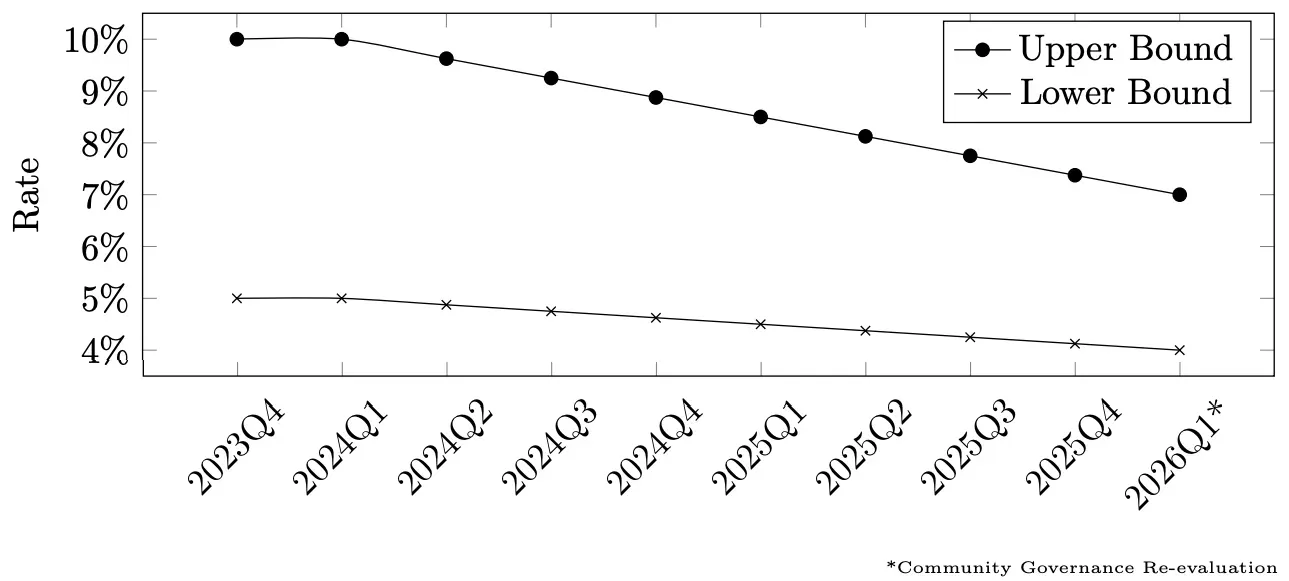
The schedule for INJ Supply Rate bound tightening set forth in INJ 3.0 is shown below in both chart and table formats:
| 2024 | 2025 | 2026 | |||||||
| Q1 | Q2 | Q3 | Q4 | Q1 | Q2 | Q3 | Q4 | Q1 | Q2+ |
Lower | 5% | 4.875% | 4.75% | 4.625% | 4.5% | 4.375% | 4.25% | 4.125% | 4% | Re-evaluate parameters for further decreases |
Upper | 10% | 9.625% | 9.25% | 8.875% | 8.5% | 8.125% | 7.75% | 7.375% | 7% | |
Deflationary Effects of INJ 3.0: The dynamic supply mechanism and the Burn Auction work together to induce deflationary activity for INJ. When the cumulative amount of INJ burned exceeds the block rewards, the total supply decreases, resulting in deflation.
Reducing the maximum Supply Rate of INJ narrows the gap to achieving deflation. Additionally, increasing the rate at which the Supply Rate adjusts block-byblock stabilizes the aggregate Supply Rate. This automated mechanism ensures a tightly controlled, responsive, and lower overall Supply Rate. In turn, this positions INJ towards inherent deflationary properties.
With INJ 3.0 significantly decreasing newly minted INJ, the duration of deflationary periods increases. As the ecosystem expands, the size of each Burn Auction is also set to grow, reinforcing this trend. The combination of upward pressure from INJ burn growth and downward pressure from a descending supply rate creates a feedback loop, leading to continual deflationary acceleration for INJ.
5 Discussion
5.1 Market Dynamics and Ecosystem Stability
The controlled release and strategic burn of INJ tokens help maintain ecosystem stability. By dynamically adjusting the token supply in response to growth and demand, Injective aims to sustain a balanced environment, mitigating excessive volatility and supporting long-term project sustainability.
Stabilization Mechanisms: Injective employs a dynamic supply mechanism along with the Burn Auction to stabilize the ecosystem. These mechanisms adjust the circulating supply based on objective economic indicators, promoting sustainable development.
User Confidence: Transparent and predictable tokenomics enhance confidence among users. Injective’s commitment to controlled supply dynamics reinforces its credibility, attracting stakeholders interested in the project’s long-term viability.
5.2 Community Engagement and Development
Active community engagement is vital for the growth and success of blockchain networks. Injective leverages its token distribution and economic strategies to foster a dynamic community, ensuring that stakeholders are incentivized to contribute positively to the ecosystem.
Community Incentives: The distribution strategy includes incentives for community participation, such as rewards for staking, contributions to ecosystem development projects, and availability of the Burn Auction. These incentives ensure active and ongoing involvement from community members, driving platform adoption, security, and utilization.
Governance and Decentralization: Governance plays a crucial role in upholding the decentralized nature of blockchain networks. INJ stakers are empowered to vote on key protocol decisions, promoting a decentralized governance structure that aligns with blockchain technology’s ethos.
5.3 Sustainability and Long-term Viability
Sustainability is a critical aspect of any digital asset or blockchain. Injective’s approach to tokenomics is designed to ensure current usability and efficiency, as well as long-term viability.
Environmental Considerations: Environmental impact is increasingly a consideration in blockchain technology. Injective aims to maintain a minimal environmental footprint by optimizing transaction processing and leveraging energyefficient consensus mechanisms. Currently, Injective’s consensus framework leads to a 99.99% smaller carbon footprint relative to other dominant consensus mechanisms found in the industry today.14
Future Outlook: Injective continues to develop and refine its strategies to adapt to changing market conditions and technological advancements. Ongoing adjustments to the tokenomics model are intended to ensure that Injective remains at the forefront of the rapidly evolving blockchain landscape. The integration of Electro Chains, designed for enhanced interoperability and technical versatility, will be pivotal in expanding Injective’s capabilities and agility to drive future growth. These initiatives exemplify Injective’s commitment to continuous innovation and maintaining its leadership in the blockchain ecosystem.
6 Conclusion
In conclusion, Injective’s innovative approach to tokenomics, characterized by dynamic supply control and strategic token burns, exemplifies a robust model for managing the economics of blockchain networks. These strategies support ecosystem growth, enhance stakeholder confidence, and promote active community engagement. The careful handling of token dynamics ensures that Injective remains a resilient and vital player in the blockchain industry.
REFERENCES [1] inj1adpadycvjcxudy3upwrw6kgf2csh536xrhj7pg. Proposal 392, 2024. https://hub.injective.network/proposal/392.
[2] Tendermint. Tendermint consensus, 2023. https://github.com/tendermint/tendermint/blob/main/spec/ consensus/consensus.md.
[3] Injective. Exchange module, 2024. https://docs.injective.network/develop/modules/Injective/ exchange/.
[4] Injective. Slashing module, 2024. https://docs.injective.network/develop/modules/Core/slashing/.
[5] Injective Labs. Injective launches inevm on mainnet: The first rollup to hyperscale concurrent vm development, 2024. https://blog.injective.com/en/injective-launches-inevm-on-mainnet-the-first-rollup-to-hyperscale-concurrent-vmdevelopment/.
[6] Injective. Governance module concepts, 2024. https://docs.injective.network/develop/modules/Core/gov/ concepts#vote.
[7] Injective. Mint module concepts, 2024. https://docs.injective.network/develop/modules/Core/mint/ concepts.
[8] Cornell University. Four common types of auctions, 2021. https://blogs.cornell.edu/info2040/2021/11/29/four-commontypes-of-auctions/.
[9] Injective. Auction module, 2024. https://docs.injective.network/develop/modules/Injective/ auction/.
[10] Injective Labs. Inj 2.0 launch, 2023. https://blog.injective.com/en/inj-burn-2-0/.
[11] Injective Labs. The all-new inj burn standard launch, 2024. https://blog.injective.com/en/the-all-new-inj-burn-standardlaunch/.
[12] Injective Labs. Injective cheat sheet, 2024. https://docs.injective.network/develop/cheat-sheet/ #contributing-to-the-burn-auction-pool.
[13] Injective Labs. Injective unveils fee reductions with gas compression, 2024. https://blog.injective.com/en/injective-unveils-feereductions-with-gas-compression/.
[14] The Interchain Foundation. Why blockchains need cosmos proof-of-stake for a sustainable environment, 2021. https://blog.cosmos.network/why-blockchains-need-cosmos-proofof-stake-for-a-sustainable-environment-878b3edd2e85.