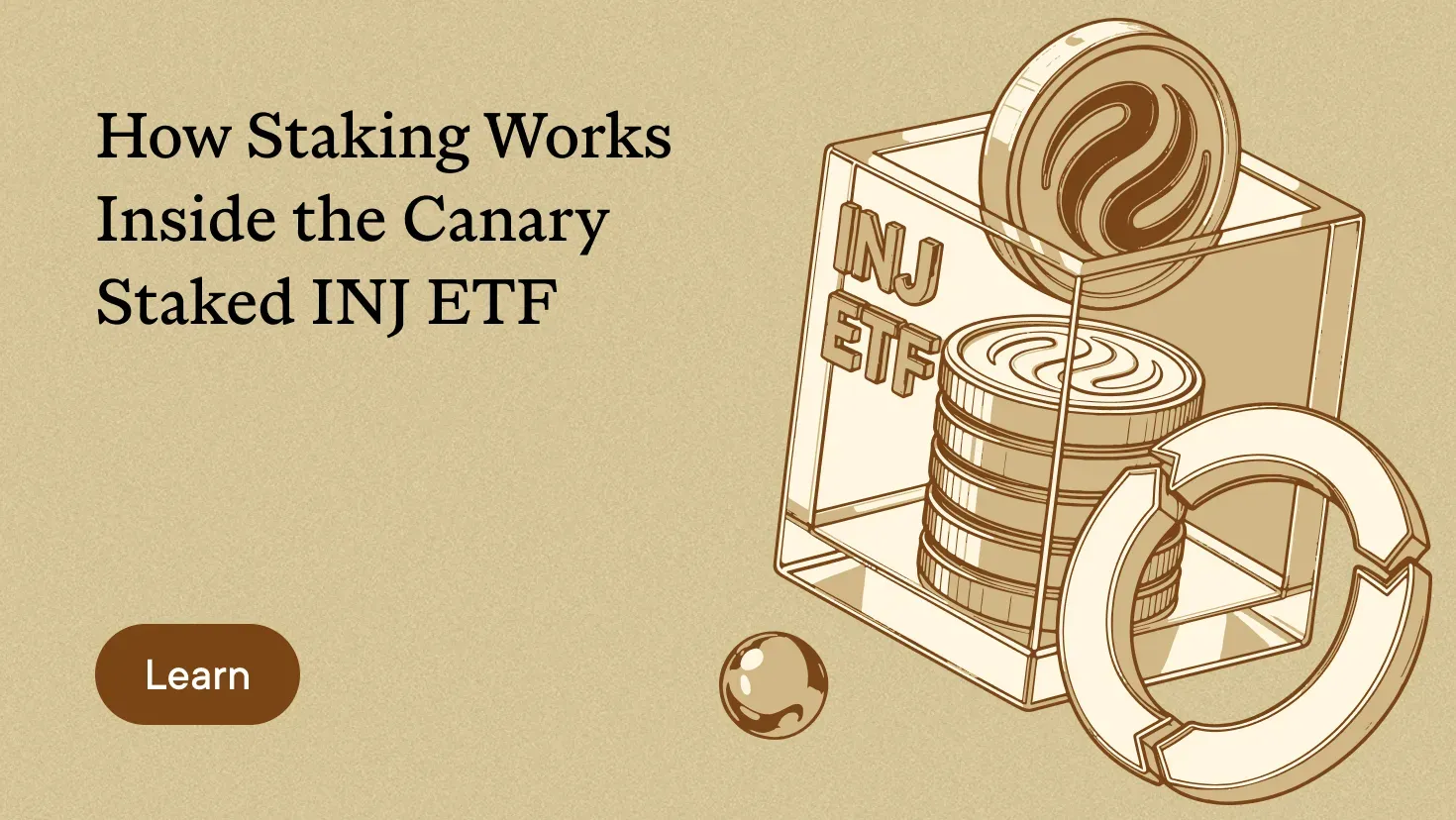
INJC, the Canary Staked INJ ETF, is designed to hold INJ and stake most of it on Injective. The plan is for staking rewards to flow back into the fund as more INJ.
That's what makes it a staked ETF. It takes the same staking that secures Injective and puts it inside a fund structure. The setup has more moving parts than a plain spot fund, and each one shapes what a shareholder ends up with.
Here's how staking is designed to work inside INJC, step by step, and where the tradeoffs are.
Staking on Injective
Injective runs on proof of stake. Validators run the network and confirm transactions. Stakers delegate INJ to those validators, which puts economic weight behind honest behavior and helps secure the chain.
Injective is built for finance, so that security sits under every trade and transfer that settles onchain. The more INJ is staked, the more value an attacker would have to put at risk.
The network pays staking rewards in INJ for that work. Rewards go to validators and the delegators who back them, after each validator takes its commission.
Delegated INJ stays with its holder. It's bonded to a validator until the holder unbonds it. That bond gives staking its security, and it's also where most of the tradeoffs below come from.
Staking Inside the Fund
Each party in the staking chain has one job. Here's the order the fund is designed to run in.
- Canary Capital, as the fund's sponsor, will run the staking program. The fund won't operate its own validator. Canary works through third-party staking providers that delegate the fund's INJ to validators on Injective.
- The fund's custodian controls the private keys for staked INJ at all times. Staking providers handle delegation. The keys stay with the custodian.
- The fund plans to stake most of its INJ and keep the rest unstaked. That unstaked INJ lets the fund handle creations and redemptions without waiting out an unbonding period. Redemptions can come in on any trading day, and staked INJ needs 21 days to unbond, so a buffer stays liquid.
- Rewards will be paid into the fund's custody wallets, minus staking fees shared by the staking provider, the sponsor and the custodian. Net rewards are included in the fund's daily NAV and restaked.
- Shareholders see rewards in the value of the fund. The fund doesn't plan to pay them out as cash, so they build up as more INJ behind each share.
The Tradeoffs
Staking adds INJ to the fund. It also adds risk, and these are the parts worth reading twice.
Rewards aren't guaranteed. They move with network conditions and validator performance, and there's no promised level. An offline validator earns nothing for its delegators while it's down. A stretch of lower network rewards means less INJ flowing into the fund. Past rewards don't set future ones.
Staking may not always be part of the fund. The share of INJ that INJC stakes can change over time, and staking itself isn't certain to continue for the life of the ETF. Anyone looking at INJC should treat staking rewards as possible, never as promised.
Unbonding takes 21 days. Once the fund unstakes INJ, that INJ can't be moved during the window and earns no rewards while it waits. The fund manages this with a liquidity risk management policy, which is why it keeps some INJ unstaked.
Slashing can happen. Validators that misbehave or go offline for long periods can lose part of their stake, and the INJ delegated to them shares that loss. Canary doesn't expect it to happen. It's still possible, and recovery isn't guaranteed.
FAQ
Do Shareholders Get Paid Staking Rewards?
The fund doesn't plan to pay them out. Net rewards are restaked and counted in the fund's daily NAV, so they show up in the value of each share. Nothing lands in a brokerage account as income. NAV also moves with the price of INJ, which can fall as well as rise. Restaked rewards grow the INJ count. They don't shield the fund from a drop in price.
How is This Different From Staking INJ Yourself?
Staking INJ directly puts you in charge. You hold the keys, pick your validators, vote on governance proposals onchain and wait out the 21-day unbonding yourself.
INJC is designed to handle the staking inside the fund. Shareholders own ETF shares, so they don't pick validators or vote onchain, and staking fees come out of rewards before they reach NAV. Our INJ vs. INJC explainer walks through the full comparison.
What Happens If a Validator Gets Slashed?
The validator loses part of its stake, and INJ delegated to it takes a share of the loss. If that validator holds part of the fund's stake, the fund could end up with less INJ. Canary considers slashing unlikely. The risk still exists, and any recovery isn't guaranteed.

About Injective
Injective is the first blockchain purpose-built for finance, enabling users, institutions, and AI agents to trade, tokenize, and transact at scale. Proudly made in America, Injective provides foundational blockchain infrastructure for global markets, with embedded financial primitives spanning stablecoins, real-world assets, payments, and programmable perpetuals through a unified onchain engine. Injective is used by Fortune 500 companies, banks, fintechs, and governments to power an open economy where any asset can be accessed anytime, from anywhere. Builders can deploy across multiple virtual machines like WASM and EVM, connect to native financial modules, and launch markets with deep liquidity from day one. INJ is the native token powering the rapidly growing Injective ecosystem and the new internet economy.
Website | Telegram | Discord | Blog | Twitter/X | Youtube | Facebook | LinkedIn | Reddit | Instagram | Orbit Newsletter