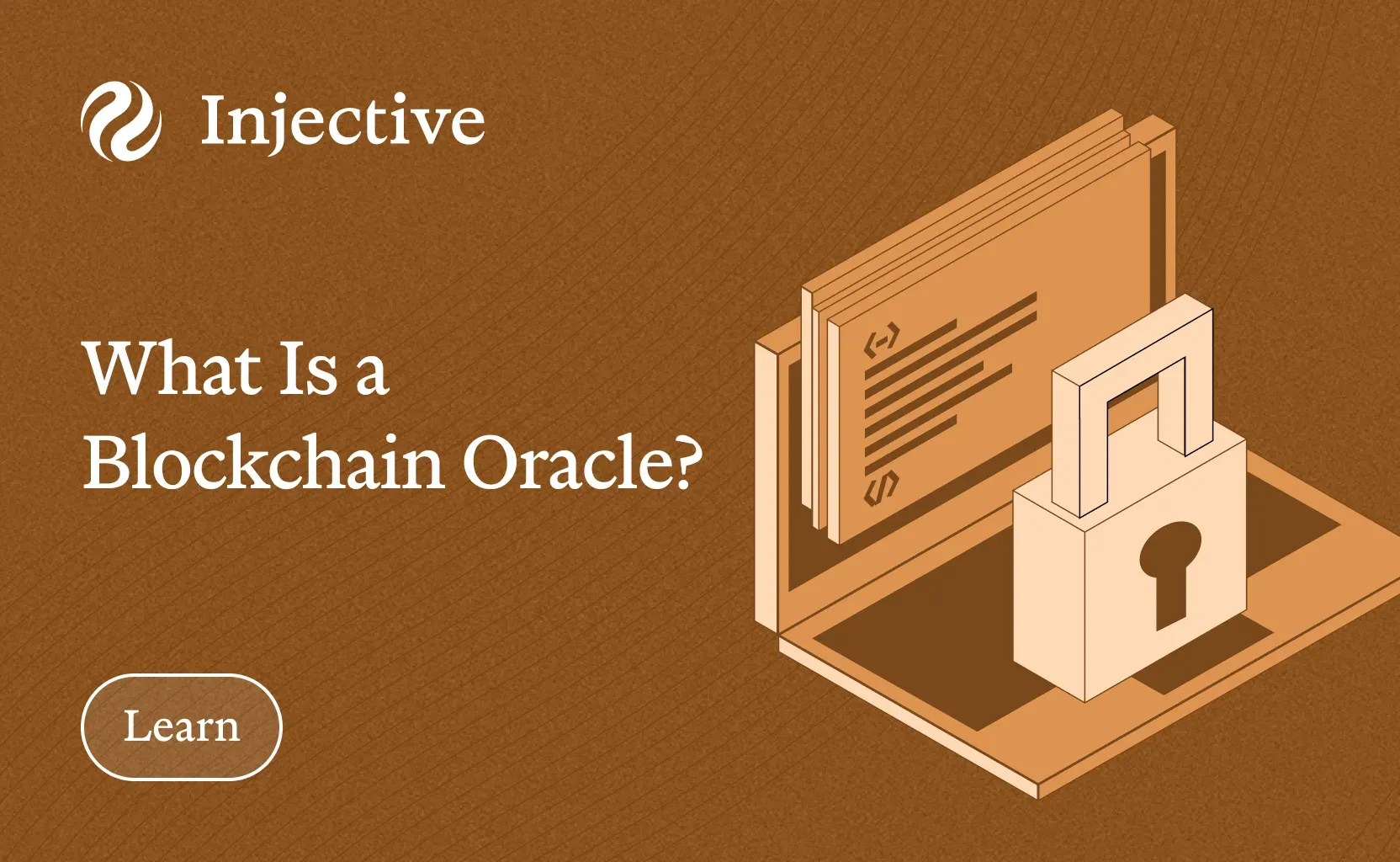
A blockchain oracle is a system that enables smart contracts to access data from outside the blockchain. Because blockchains are closed environments, they cannot natively read information such as asset prices, interest rates, weather data, or real-world events. Oracles bridge this gap by delivering offchain data to onchain smart contracts in a way that those contracts can understand and act upon.
In practice, blockchain oracles are a foundational piece of infrastructure for decentralized applications. Without oracles, many of the most common smart contract use cases—such as decentralized exchanges, lending protocols, derivatives, and prediction markets—would not be possible.
For anyone learning about decentralized finance or smart contracts, understanding how blockchain oracles work is essential. They define how external information enters the blockchain world and directly influence the security, accuracy, and reliability of onchain systems.
On Injective, oracles play a critical role in enabling advanced financial applications. Injective’s architecture relies on accurate, low-latency data feeds to support trading, derivatives, and other DeFi primitives, as documented in the Injective Docs.
How Blockchain Oracles Work
At a conceptual level, a blockchain oracle acts as a data messenger between the real world and a smart contract. The oracle retrieves information from an external source, verifies or processes that data, and then submits it onchain so a smart contract can use it.
Because smart contracts execute deterministically, the quality of oracle data is critical. Incorrect, delayed, or manipulated data can lead to incorrect contract execution, financial losses, or systemic risk.
Step-by-step flow
- Data request: A smart contract requests specific external data, such as an asset price.
- Data retrieval: The oracle collects information from one or more offchain sources.
- Verification and aggregation: Data may be validated, aggregated, or filtered to reduce errors or manipulation.
- Onchain delivery: The oracle submits the data to the blockchain.
- Smart contract execution: The contract uses the data to trigger logic, such as settling a trade or liquidating a position.
What users actually interact with
End users rarely interact directly with oracles. Instead, oracles operate behind the scenes, supplying data to applications such as exchanges, lending platforms, or derivatives protocols. Users experience oracle behavior indirectly through application outcomes like prices, liquidations, or settlement conditions.
Technical constraints
Oracle systems face several constraints:
- Data freshness and update frequency
- Network latency
- Source reliability
- Onchain transaction costs
These constraints influence how frequently data can be updated and how resilient the oracle system is under stress.
Why Blockchain Oracles Are Needed for Smart Contracts
Smart contracts are powerful because they execute automatically based on predefined rules. However, they cannot natively observe the external world. Without oracles, smart contracts would be limited to purely onchain inputs.
Blockchain oracles allow smart contracts to respond to real-world conditions. For example, a lending protocol needs up-to-date asset prices to determine collateral values, while a derivatives contract requires reliable settlement prices.
By enabling smart contracts to reference external data, oracles significantly expand what blockchains can do.
Key Properties of Blockchain Oracles
Data accuracy
The usefulness of an oracle depends on the accuracy of the data it provides. Reliable oracle systems often use multiple independent data sources and aggregation mechanisms to reduce errors and outliers.
Accurate data is especially important in financial applications, where small price discrepancies can lead to incorrect liquidations, unfair settlements, or arbitrage opportunities.
Decentralization
Decentralized oracles rely on multiple independent data providers rather than a single source. This reduces the risk of manipulation, censorship, or downtime caused by any one operator.
Decentralization also improves fault tolerance. If one data provider fails or submits incorrect information, the system can still function correctly.
Timeliness
Oracle data must be delivered quickly enough to remain relevant. In fast-moving markets, delayed data can be just as harmful as incorrect data.
Oracle designs must balance update frequency with onchain transaction costs, especially during periods of high network activity.
Transparency
Strong oracle systems make their data sources, aggregation logic, and update mechanisms visible to users and developers. Transparency allows applications to assess risk and build safeguards.
Who typically relies on oracles
Blockchain oracles are used by:
- DeFi protocols
- Trading and derivatives platforms
- Stablecoin systems
- Prediction markets
- Insurance applications
Types of Blockchain Oracles
Not all oracles are designed for the same purpose. Different applications require different data guarantees, update frequencies, and trust assumptions.
Price oracles
Price oracles deliver asset prices to smart contracts. They are commonly used by decentralized exchanges, lending protocols, and derivatives platforms.
Price oracles often aggregate data from multiple exchanges or markets to reduce manipulation risk. In some designs, prices are updated continuously, while in others they are updated at fixed intervals.
Event oracles
Event oracles report on real-world outcomes, such as election results, sports outcomes, regulatory events, or weather conditions. These oracles are critical for prediction markets and insurance protocols.
Because events may not have objective numerical values, event oracles often rely on multiple reporters or consensus mechanisms to determine outcomes.
Computation oracles
Computation oracles provide offchain computation rather than raw data. They allow complex calculations to be performed offchain and verified onchain, enabling advanced smart contract logic without excessive onchain costs.
Centralized vs Decentralized Oracles
Centralized oracles rely on a single data provider or operator. While they can be fast and simple to implement, they introduce a single point of failure.
Decentralized oracles distribute data collection and reporting across multiple independent participants. This design improves resilience but introduces coordination and incentive challenges.
Understanding this trade-off is essential when evaluating oracle systems for production use.
Main Use Cases of Blockchain Oracles
Price feeds for DeFi applications
Price oracles supply real-time or near-real-time asset prices to decentralized exchanges, lending protocols, and derivatives platforms. Accurate price feeds are essential for functions like trade execution, margin calculations, and liquidations.
Settlement of derivatives and contracts
Derivatives contracts rely on oracle data to determine settlement conditions. For example, a perpetual futures contract uses oracle prices to calculate funding rates and mark prices.
Stablecoin mechanisms
Some stablecoins depend on oracle data to maintain their peg. Oracles provide reference prices that inform minting, burning, or rebalancing mechanisms.
Event-based smart reminders
Prediction markets and insurance protocols use oracles to verify real-world events, such as election outcomes or weather conditions, before executing payouts.
Why Blockchain Oracles Matter Today
As blockchain adoption increases, the demand for reliable external data grows. DeFi protocols handle billions of dollars in value, and even small oracle failures can have outsized consequences.
Blockchain oracles matter today because they:
- Enable complex smart contract functionality
- Support onchain financial markets
- Reduce reliance on centralized intermediaries
- Help maintain fairness and transparency
As applications become more sophisticated, oracle design and security become increasingly important.
Risks and Challenges
Blockchain oracles introduce unique risks because they sit at the boundary between blockchains and the external world.
One major risk is oracle manipulation. If an attacker can influence data sources, aggregation logic, or submission mechanisms, they may be able to trigger favorable smart contract outcomes.
Another challenge is data availability. Network outages, source failures, or congestion can delay updates, affecting dependent applications.
Oracles also introduce governance and configuration risk. Incorrect parameters, outdated sources, or poorly designed update rules can undermine system reliability.
Common oracle risks include:
- Single-source dependency
- Low-liquidity reference markets
- Delayed updates during volatility
- Governance or configuration errors
Mitigating these risks requires careful oracle design, decentralization, monitoring, and fallback mechanisms.
Real-World Oracle Failures and Lessons
Several high-profile DeFi incidents have highlighted the importance of oracle design.
In many cases, attackers exploited thin liquidity markets or delayed updates to manipulate prices used by smart contracts. These incidents often resulted in cascading liquidations or loss of funds.
The key lesson from these events is that oracle security is not only a technical problem, but also a market design and risk management challenge.
Blockchain Oracles on Injective
Injective integrates oracle infrastructure to support its onchain trading and derivatives ecosystem. Accurate price feeds are essential for maintaining fair markets and protecting users from incorrect liquidations.
By combining fast block times with robust oracle mechanisms, Injective enables applications to operate with low latency and high reliability. This design supports advanced use cases such as derivatives trading on an onchain order book.
Developers building on Injective can rely on oracle data as a core component of smart contract logic.
How to Get Started With Blockchain Oracles
Blockchain oracles are an advanced topic, but there are clear ways to begin learning and experimenting safely.
Prerequisites
- Basic understanding of blockchain technology
- Familiarity with smart contracts and DeFi
- Awareness of oracle-related risks
Practical learning path
- Learn how smart contracts request and consume external data
- Study different oracle architectures and their trade-offs
- Review how price feeds are used in DeFi protocols
- Explore Injective documentation and ecosystem examples
- Experiment in test environments before deploying contracts
Operational considerations
Developers should consider update frequency, fallback mechanisms, and monitoring when integrating oracles. Poor operational practices can undermine even well-designed oracle systems.
FAQ
What is a blockchain oracle in simple terms?
A blockchain oracle is a system that brings external data, such as prices or events, onto the blockchain so smart contracts can use it.
Why do smart contracts need oracles?
Smart contracts cannot access offchain data on their own, so oracles provide the information needed to execute real-world logic.
Are blockchain oracles centralized?
Some oracles are centralized, while others are decentralized and use multiple data sources to reduce risk.
What happens if an oracle fails?
If an oracle fails or provides incorrect data, dependent smart contracts may behave incorrectly, leading to losses or disruptions.
Are oracles secure?
Oracle security depends on design, data sources, and decentralization. Strong oracle systems reduce risk but cannot eliminate it entirely.