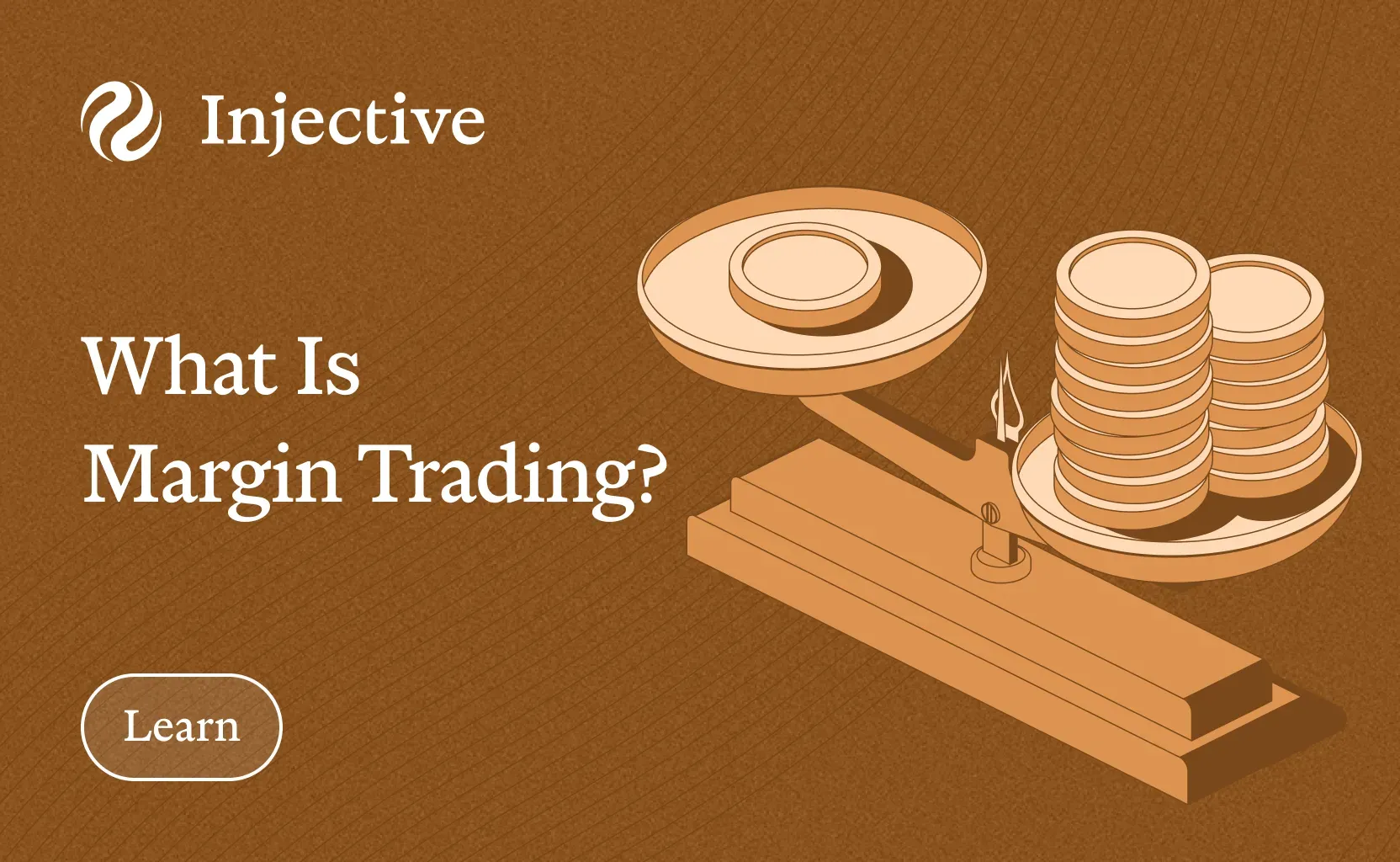
Margin trading is a trading strategy that allows traders to borrow funds in order to increase the size of their positions. By using borrowed capital, traders can gain greater exposure to price movements than would be possible using only their own funds. While this can amplify potential profits, it also significantly increases risk.
Margin trading is widely used across traditional finance and crypto markets. In the context of digital assets, margin trading enables participants to take larger positions, hedge exposure, and implement more advanced trading strategies.
For anyone exploring active or leveraged trading, understanding margin trading is essential. It introduces concepts such as leverage, collateral, margin requirements, and liquidation risk.
On Injective, margin trading is supported within a decentralized, onchain trading environment. Injective’s architecture enables margin-based trading while maintaining transparency and user custody.
How Margin Trading Works
Margin trading involves borrowing funds from a platform or liquidity pool and using those funds as part of a trading position. The trader provides collateral, which serves as security for the borrowed amount.
Leverage is created when borrowed funds are combined with the trader’s own capital. The total position size is larger than the trader’s initial investment.
Step-by-step flow
- Collateral deposit: The trader deposits collateral into a margin account.
- Leverage selection: The trader chooses the desired leverage level.
- Position opening: A leveraged position is opened using borrowed funds.
- Position monitoring: The trader monitors price movements and margin levels.
- Position closure or liquidation: The position is closed manually or liquidated if margin requirements are breached.
What traders actually interact with
Traders typically interact with trading interfaces that display leverage levels, margin ratios, unrealized profit and loss, and liquidation prices. Understanding these metrics is critical when trading on margin.
Technical constraints
Margin trading is affected by:
- Market volatility
- Liquidity depth
- Oracle accuracy
- Execution speed
These factors directly influence risk and execution quality.
Why Margin Trading Exists
Margin trading exists to provide traders with greater capital efficiency and flexibility. By allowing traders to borrow funds, margin systems enable larger positions without requiring full capital upfront.
In professional markets, margin trading is often used for hedging, arbitrage, and short-term strategies rather than long-term investing.
Key Concepts in Margin Trading
Leverage
Leverage represents the ratio between a trader’s own capital and the total position size. For example, using 5x leverage means controlling a position five times larger than the initial collateral.
Higher leverage magnifies both gains and losses. Even small price movements can have outsized effects on account balances, which is why leverage is considered an advanced trading tool.
Margin and collateral
Margin refers to the minimum amount of collateral required to open and maintain a leveraged position. Collateral acts as a safety buffer for borrowed funds and helps protect lenders and the trading system.
If losses reduce available margin below required thresholds, traders may face liquidation.
Initial and maintenance margin
Initial margin is the amount required to open a leveraged position, while maintenance margin is the minimum amount required to keep it open. Falling below maintenance margin typically triggers liquidation mechanisms.
Liquidation
Liquidation occurs when losses reduce a trader’s margin below required levels. Positions are forcibly closed to prevent further losses and to maintain system solvency.
Understanding liquidation mechanics is critical for managing leveraged positions.
Main Use Cases of Margin Trading
Short-term speculation
Margin trading is commonly used for short-term speculation. Traders seek to profit from rapid price movements by increasing exposure through leverage.
Because markets can move quickly, this use case requires active monitoring and strict risk controls.
Hedging positions
Margin trading allows traders to hedge spot exposure without selling underlying assets. For example, a trader holding spot tokens may open a short leveraged position to offset downside risk.
Capital efficiency
Leverage enables traders to deploy capital more efficiently. Rather than allocating full capital to a single position, traders can distribute funds across multiple strategies.
Arbitrage and relative value strategies
Advanced traders use margin trading to exploit price differences across markets or instruments. These strategies often rely on precise execution and risk management.
Why Margin Trading Matters Today
As crypto markets mature, traders seek more sophisticated tools for managing risk and exposure.
Margin trading matters today because it:
- Enables advanced trading strategies
- Increases market liquidity
- Supports price discovery
Risks and Challenges
Margin trading introduces substantial risks that traders must understand before using leverage.
Liquidation risk is one of the most significant dangers. Sudden price movements can quickly erase collateral, especially at high leverage levels.
Amplified losses are another concern. While leverage can magnify gains, it also magnifies losses, potentially exceeding initial expectations.
Emotional pressure often increases when trading with borrowed funds. Stress, fear, and overconfidence can lead to poor decision-making.
Margin trading also depends on accurate pricing data and sufficient liquidity. Issues with oracles, thin markets, or execution delays can worsen outcomes.
Understanding these risks is essential for responsible margin trading.
Margin Trading vs Spot Trading
Spot trading involves buying or selling assets for immediate settlement and direct ownership. When traders buy an asset on the spot market, they fully own that asset and are exposed only to its price movements.
Margin trading differs by allowing traders to borrow funds to increase position size. Instead of owning only the amount purchased with their capital, traders gain amplified exposure through leverage. This amplification introduces margin requirements and liquidation risk.
Key differences include:
- Spot trading does not involve borrowing or liquidation risk
- Margin trading increases exposure through leverage
- Spot trading is generally more suitable for beginners
Understanding these differences helps traders choose the appropriate approach based on experience and risk tolerance.
Cross Margin vs Isolated Margin
Margin trading platforms typically offer two margin models: cross margin and isolated margin.
Cross margin uses all available collateral across positions to prevent liquidation. This approach can reduce the likelihood of liquidation but exposes the entire account balance to risk.
Isolated margin assigns collateral to a single position. Losses are limited to the isolated amount, but liquidation risk may occur more quickly.
Choosing between cross and isolated margin depends on strategy, risk appetite, and position management preferences.
Long and Short Positions Using Margin
Margin trading allows traders to open both long and short positions.
Long positions benefit from rising prices. Traders borrow funds to increase exposure to upward price movements.
Short positions benefit from falling prices. Traders borrow assets to sell them, aiming to repurchase at lower prices.
Understanding long and short mechanics is essential for managing directional risk when trading on margin.
Liquidation Mechanics Explained With an Example
Liquidation occurs when a trader’s margin falls below required maintenance levels.
For example, a trader opens a leveraged position using 5x leverage with $1,000 in collateral, controlling a $5,000 position. If the market moves against the position by 20 percent, the losses may exhaust the collateral, triggering liquidation.
This example highlights how leverage magnifies losses and why conservative leverage is critical.
Role of Oracles and Pricing in Margin Trading
Margin trading systems rely on accurate pricing data to calculate margin ratios, unrealized profit and loss, and liquidation thresholds.
Oracles supply reference prices that determine whether positions remain healthy or are subject to liquidation. Delayed, manipulated, or low-quality pricing data can increase liquidation risk or result in unfair position closures.
For this reason, robust oracle design and conservative risk parameters are essential components of any margin trading system.
Trading Psychology and Leverage
Trading with leverage introduces psychological pressures that are significantly different from spot trading.
Because gains and losses are amplified, traders may experience heightened emotional responses such as fear, stress, or overconfidence. These emotions can lead to impulsive decisions, including holding losing positions too long or increasing leverage after short-term wins.
Successful margin traders focus on process rather than outcomes. They define risk limits in advance, accept losses as part of trading, and avoid making decisions based on short-term price fluctuations.
Understanding the psychological impact of leverage is just as important as understanding the technical mechanics of margin trading.
Margin Trading on Injective
Injective supports margin trading within a decentralized trading framework. Traders maintain custody of their assets while accessing leverage-enabled markets.
How to Get Started With Margin Trading
Margin trading is an advanced activity and should be approached cautiously.
Prerequisites
- Strong understanding of spot trading
- Familiarity with leverage and margin concepts
- Comfort with active risk management
Practical learning path
- Learn margin trading terminology and mechanics
- Start with the lowest possible leverage
- Monitor margin ratios and liquidation prices closely
- Use clear entry and exit rules
- Gradually increase complexity as experience grows
Risk management best practices
Effective risk management is critical when trading on margin. Traders should use conservative leverage, define maximum loss limits, and avoid overexposing capital to a single position.
FAQ
What is margin trading in simple terms?
Margin trading allows traders to borrow funds to increase the size of a trading position.
What is leverage in margin trading?
Leverage is the use of borrowed funds to amplify exposure to price movements.
Why is margin trading risky?
Because leverage magnifies losses and can lead to liquidation if margin requirements are breached.
Is margin trading suitable for beginners?
Margin trading is generally not recommended for beginners due to its complexity and risk.
What happens during liquidation?
When losses exceed allowed limits, positions are forcibly closed to protect the trading system.
Can margin trading be used for hedging?
Yes. Traders can use margin positions to offset risk in spot holdings.
How does margin trading differ from derivatives?
Margin trading uses borrowed funds directly, while derivatives use contracts to gain exposure.