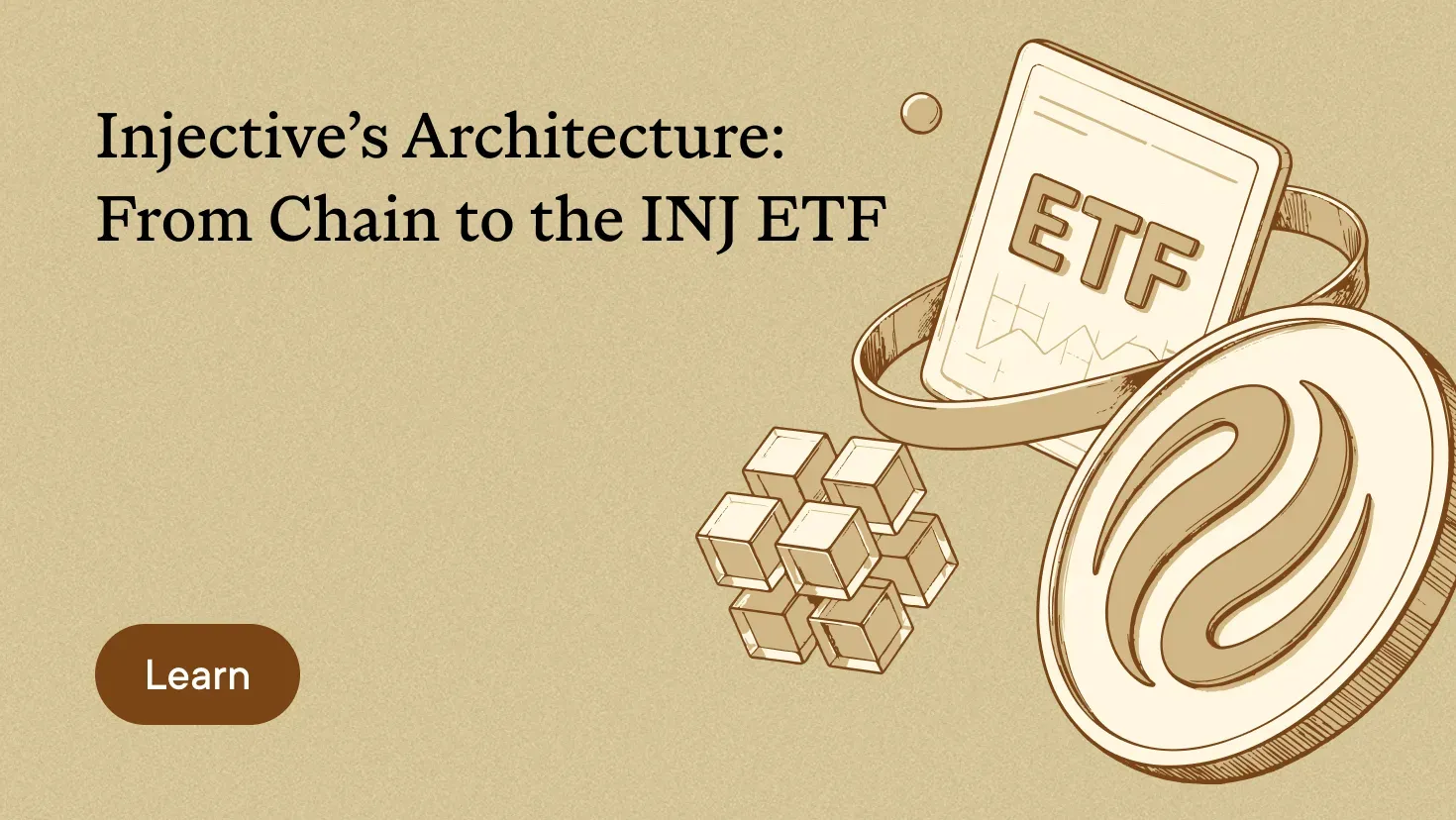
Injective’s blockchain is just one piece of the financial plumbing that powers Injective’s onchain network. INJ is the core asset powering the blockchain and its rapidly growing ecosystem of decentralized applications. INJC is the ticker for the proposed Canary Staked INJ ETF, which would hold and stake INJ on behalf of shareholders.
Simply put, the Injective blockchain settles financial activity, the token supports its operation, and the ETF would package exposure through a familiar brokerage account. Understanding each part explains what happens when a user places a trade, delegates tokens, or holds an ETF share.
Injective Connects Financial Apps Through One Network
Injective is a blockchain built for finance. It gives financial institutions, enterprises, trading platforms, lending services, payment tools, and businesses creating digital assets a shared system for recording activity and completing transactions. Each application has its own interface. The network underneath connects them all.
There are three main parts that work together to make the Injective network function:
- Applications: These are what users see and interact with.
- Infrastructure: Financial tools within the network that handle jobs such as matching buyers with sellers, updating balances, and creating digital assets.
- Validators: Independent operators check transactions and agree on the shared record.
For example, a user approves the trade in their wallet. The app sends it to Injective. The network's modules check the rules, execute the trade, and update both sides' balances. Validators then confirm the result and add it to the record.
Tokenization Brings Financial Assets Onto Injective
Tokenization means creating a record of an asset on a blockchain. The token might represent an investment interest, a payment claim, or data tied to a loan. What the holder actually owns, and who is allowed to hold it, is set by the product's legal terms. The token carries those terms. It does not replace them.
Injective Mint gives businesses one interface for creating and managing these assets. An issuer decides who can hold a token, where it can be transferred, and who can create or redeem it. Injective enforces those rules every time the asset moves.
Two examples show what this looks like in practice. Pineapple Financial has tokenized more than $1 billion in funded mortgage records on Injective. Each token points to an existing loan file, so authorized parties can all inspect the same record. The mortgage itself keeps its original legal and servicing arrangements.
In South Korea, POSCO International, one of the country's largest trading companies, and LG CNS chose Injective for a trade finance pilot. The project turns customer payment obligations into digital assets so participating companies can track who owns each claim and whether it has been paid.
Injective today is one of the largest chains ranked by total real world asset value and is the leading blockchain for tokenized real estate.
INJ Connects Network Use With Security and Governance
INJ has three roles on the network. It pays fees, it secures the chain through staking, and it gives stakers a vote.
Every transfer or onchain action costs a small amount of INJ. The fee is based on gas, a measure of how much computing work the action requires, multiplied by the gas price.
Staking is how INJ secures the network. Holders delegate their INJ to validators, and the amount delegated to a validator determines its voting power. In return, delegators earn a share of protocol rewards after the validator takes its commission. How much they earn depends on token issuance, network activity, how much INJ is staked overall, and how well their validator performs.
Staking does not require running a validator. Holders pick one through a supported wallet, and the beginner's staking guide covers the steps.
Staked INJ also carries voting power in governance, where the community decides on upgrades and protocol settings. Delegators can vote directly. If they skip a proposal, their validator's vote counts for them.
Owning INJ means owning a digital asset with uses on the network. It is not equity in a company. Staking grows the number of tokens you hold, but their dollar value still depends on INJ's market price. Your actual return reflects both. The beginner’s staking guide explains the process.
Revenue is Used to BuyBack INJ, Reducing INJ Supply
NJ supply moves in two directions. The protocol issues new INJ to fund staking rewards, and burns permanently remove INJ from circulation. The net change in supply is the difference between the two. Burns reduce supply, but price is still set by market demand.
The INJ Supply Squeeze tightened issuance parameters and paired them with recurring burns, which slows the rate at which new tokens enter circulation. Reward issuance and token removal now sit within one monetary framework.
The Community BuyBack ties burns to ecosystem revenue. During each round, participants commit INJ in exchange for a proportional share of a basket of assets collected from activity across the ecosystem. When the round closes, all committed INJ is burned. Someone who contributes 1% of a round's total INJ receives 1% of the revenue basket.
Active participation in the injective network is required to earn entry into the Community BuyBack. Each round has its own eligibility rules, slot limits, and commitment caps. The token burn explainer and the Community BuyBack guide go through the mechanics in detail.
INJC Would Bring INJ Exposure Into Traditional Brokerage Accounts
Canary Capital has filed with the SEC to launch a trust that would hold INJ under the ticker INJC. BitGo Bank & Trust would custody the tokens. The fund would own INJ directly and aim to track its price plus staking rewards, minus expenses.
INJC shareholders would own an interest in the trust, not the tokens themselves. The INJ stays with the custodian, and service providers handle the wallet and staking. That also means a fund share has no use onchain. It cannot pay transaction fees or interact with Injective apps.
What it would offer is convenience. Investors could get exposure to INJ and its staking rewards without setting up a wallet or managing delegation themselves.
Under normal conditions, the filing targets staking at least 90% of the trust's INJ, keeping the rest available for redemptions and expenses. Staking providers would run validation while the custodian holds the private keys. Rewards would generally be restaked, adding to the trust's INJ holdings over time.
Injective’s Canary ETF announcement explains the original filing.
Putting It All Together
The Injective network settles transactions and gives financial apps shared infrastructure to build on. INJ pays for network activity, secures the chain through staking, and gives stakers a say in governance, while issuance and burns determine its supply. INJC, if approved, would hold and stake INJ inside a trust so investors can gain exposure from a brokerage account. Using the network, holding INJ, and owning an ETF share each come with different rights and access, and it helps to know which is which before choosing one.

About Injective
Injective is the first blockchain purpose-built for finance, enabling users, institutions, and AI agents to trade, tokenize, and transact at scale. Proudly made in America, Injective provides foundational blockchain infrastructure for global markets, with embedded financial primitives spanning stablecoins, real-world assets, payments, and programmable perpetuals through a unified onchain engine. Injective is used by Fortune 500 companies, banks, fintechs, and governments to power an open economy where any asset can be accessed anytime, from anywhere. Builders can deploy across multiple virtual machines like WASM and EVM, connect to native financial modules, and launch markets with deep liquidity from day one. INJ is the native token powering the rapidly growing Injective ecosystem and the new internet economy.
Website | Telegram | Discord | Blog | Twitter/X | Youtube | Facebook | LinkedIn | Reddit | Instagram | Orbit Newsletter